Key takeaways
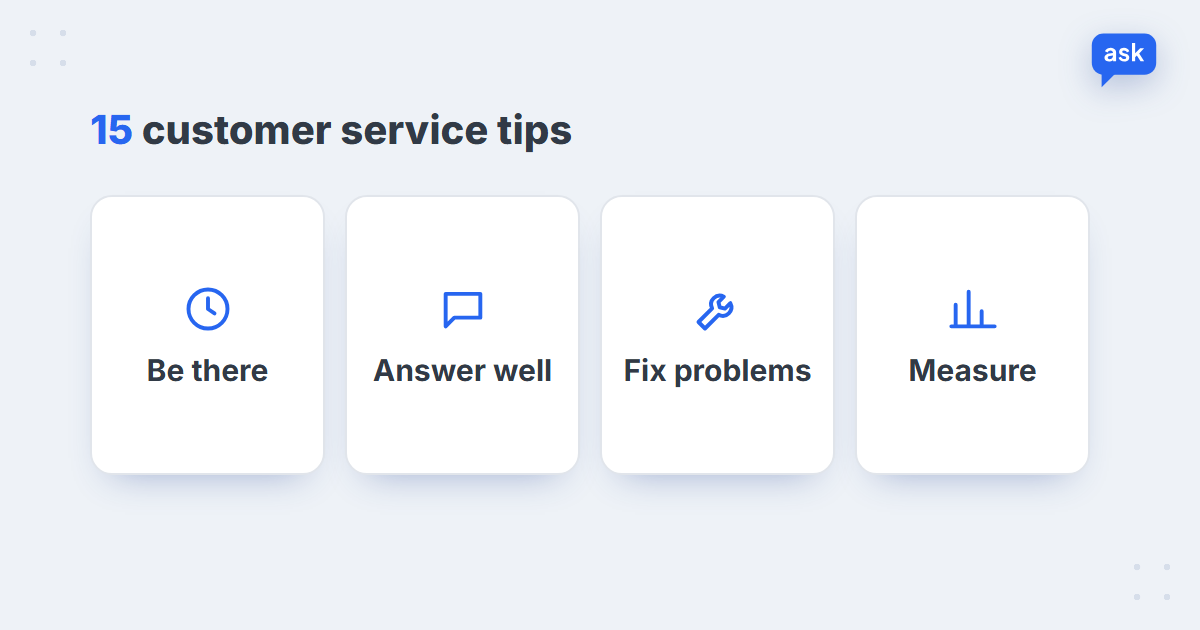
- Be there when shoppers ask – most store chats start outside office hours.
- Answer from one source of truth: a knowledge base, real order data, current policies.
- Fix problems with a clear process and a handover that never makes the customer repeat themselves.
- Measure satisfaction and resolution, read real conversations every week, and automate what repeats.
Why customer service decides the second order
In an online store, customer service does two jobs. Before the purchase it helps shoppers decide – which product, which size, will it arrive in time. After the purchase it keeps the promise – where the parcel is, how to return it, what to do when something broke. The first job wins the order; the second decides whether there is a next one.
The two jobs come through different channels. Across the online stores we analysed, most chats are about buying and most support emails are about orders that already happened:
61%
of chats arrive outside Mon–Fri 9–17
AskSpot Internal Data
74%
of chats are about buying, not past orders
AskSpot Internal Data
66%
of support emails are about orders, returns and complaints
AskSpot Internal Data
Median store, 27 September – 26 October 2026. Method and ranges in AI chatbot statistics for e-commerce.
Be there when customers need you
1. Answer when the question is asked – including after hours
Shoppers browse after work and at weekends, and a question that waits until Monday morning often means a sale that went elsewhere. You don’t need a night shift; you need an answer that doesn’t depend on someone being at a desk. The case and the numbers are in 24/7 customer support for online stores.
2. Tell customers before they ask
A shipping delay, a product that’s out of stock, a search with no results – each one will produce a question. A short, timely message prevents it: an email about the delay, a note on the product page, a chat greeting on the right page. Examples in proactive customer service.
3. Make “where is my order?” self-service
It is the most common post-purchase question in almost every store, and it needs data, not judgement. A tracking page, a clear shipping email and an assistant that checks the real status after the customer confirms the order number take it off your team’s plate. How it works: can AI handle “where is my order?”.
Answer well
4. Know your top 20 questions
In most stores a small set of questions makes up most of the volume: delivery times, returns, sizing, payment, stock. Write them down, with the answer you want customers to get. The list is the backbone of your FAQ page, your templates and any AI you add later. Real examples by category: e-commerce FAQ examples.
5. Keep one source of truth
When the returns page says 30 days, the FAQ says 14 and one consultant remembers “it depends”, customers get three answers. Keep policies in one knowledge base, update it when something changes and point everything – people, templates, chat – at it. How to build one: knowledge base for an online store.
6. Use templates, but make them personal
Templates save time and keep answers consistent. Sent unchanged, they read like a form letter – and they can’t know this customer’s order or problem. Use them as a starting point and fill in the specifics. Ready-to-use examples: canned responses for e-commerce support.
7. Answer in the customer’s language
If you sell abroad, a reply in English to a question in Czech or Hungarian costs you trust – and often the order. Shoppers ask more and buy more confidently in their own language. What changes when you sell in several markets: selling in Europe.
8. Help customers choose, not just find
Most chat questions come before the purchase: which model, which size, will it fit. A link to a category page doesn’t answer them. Advice does – a recommendation with a reason. Where a search bar runs out and a conversation takes over: site search vs AI chat.
The best answer is the one after which the customer does something – orders, tracks the parcel, sends the return. Write answers with that next step in mind.
Fix problems properly
9. Have a complaint process, not just good intentions
Complaints go badly when nobody knows who decides, what the store can offer and how fast it should reply. Write the steps down: acknowledge, collect the facts, decide, put it right, follow up. A six-step process you can copy: how to handle customer complaints.
10. Make returns easy to start
A customer who wants to return something is already disappointed; a return that takes three emails to start makes it worse. Explain the rules in plain words, including the exceptions, and let customers begin a return without waiting for a reply.
11. Hand over with the full context
Nothing annoys customers like explaining the problem twice. When a chat or an AI passes a case to a person, the conversation, the order and what has already been tried should go with it. How chat and live agents work together: live chat vs AI chat.
Measure and improve
12. Ask for a rating after every conversation
One question, one click: “How would you rate the support you received?” Track the score per channel and per topic, and read every low rating. Questions, formulas and benchmarks: CSAT for online stores.
13. Count resolved cases, not handled ones
A conversation that ended is not the same as a problem that was solved. If the customer comes back tomorrow with the same question, the first reply didn’t work. Why the difference matters: deflection vs resolution rate.
14. Automate what repeats
Questions that come in every day, always get the same kind of answer and need data rather than judgement – order status, delivery times, invoice copies – are the ones to automate first. Your team gets time back for the cases that need a person. Where to start: customer service automation. If you’d rather keep a person on every reply, start with agent assist.
15. Read real conversations every week
Dashboards tell you how much; conversations tell you why. Half an hour a week reading chats and emails shows which answers confuse people, which products raise the same doubts and which policy needs rewriting. It is the cheapest improvement in customer service – and the one most stores skip.
Where AI fits in good customer service
Several of these tips are easier with AI – answering after hours, replying in the customer’s language, checking order status, advising on products – as long as the AI answers only from your own data and hands over to your team when it should. An AI Chat Agent covers the questions before the purchase on your site; an AI Inbox Agent covers the support inbox after it. The rest – judgement, goodwill, fixing what went wrong – stays with people. The full picture: AI customer service for e-commerce.
Answer every shopper, day and night
Book a short demo – we’ll show the Agents answering product and order questions from your own catalogue and data.
FAQ
What are the most important customer service tips for an online store?
Be available when shoppers ask, answer from one source of truth, fix problems with a clear process, and measure satisfaction and resolution. Everything else builds on those four.
How can a small online store improve customer service?
Start with the top 20 questions: write the best answer to each, put them in a knowledge base and on your FAQ page, and make order tracking self-service. Then add a way to answer outside office hours, which is when most shoppers browse.
What makes good customer service in e-commerce?
Fast and correct answers, in the customer’s language, from people or tools that know the order and the policies – and a problem solved the first time, without the customer having to repeat themselves.
How do I measure customer service quality?
Use CSAT after each conversation, the share of cases resolved (not just handled), time to first reply, and how often customers come back with the same problem. See CSAT for online stores.
Should an online store use AI for customer service?
For repetitive questions, after-hours coverage and other languages, yes – if the AI answers only from the store’s own data and hands over to a person when needed. Complaints and exceptions are still best handled by your team.