Key takeaways
- In agentic commerce an AI agent takes steps for the shopper – not just answers. The shopper sets the goal and confirms the payment.
- There are two kinds of agent: the shopper’s (ChatGPT, Gemini and similar tools) and the store’s own, on its website. They need different things from you.
- Buying inside AI tools is still early: OpenAI scaled back in-chat checkout in March 2026 and Google’s Buy button covers selected US merchants. Discovery by AI is already real.
- What a store can do today: a clean product feed, policies an AI can read, and its own agent that sells on its own site.
What is agentic commerce?
Agentic commerce is online shopping in which an AI agent carries out steps of the purchase on someone’s behalf. Instead of the shopper searching, filtering, comparing and filling in forms, they give the agent a goal – “a two-person tent for a weekend in the mountains, under €200, delivered by Friday” – and the agent finds options, narrows them down, fills the cart and prepares the checkout. The shopper stays in control of the decisions that matter: which product, and the payment.
It is the next step after conversational commerce. A conversational assistant answers and advises, and the shopper still does the clicking. An agent does the clicking too. What makes it an agent is not the chat window but what it is allowed to do: look things up in several places, decide what to check next and take actions in a store.
Two kinds of AI shopping agent: the shopper’s and the store’s
Most articles about agentic commerce talk about one kind of agent. For a store owner there are two, and they need different things from you.
| The shopper’s agent | The store’s agent | |
|---|---|---|
| Examples | ChatGPT, Gemini, Perplexity and other general AI assistants | An AI agent in the chat on your own website or app |
| Works for | The shopper, across many stores | Your store and your shoppers |
| Knows | What it can read about you: your product feed, your pages, reviews elsewhere | Your full catalogue, stock, policies and – after verification – the customer’s orders |
| Can do | Find and compare products; in some programmes, start a checkout | Advise, check fit, fill the cart, prepare checkout, handle orders and returns |
| What you control | The data you publish and the programmes you join | Everything: the answers, the rules, the handover to your team |
The shopper’s agent is a new channel you need to be visible in. The store’s agent is part of your shop – the sale, the data and the customer relationship stay with you. The argument for keeping the buying moment on your own site is in AI product discovery: keep shoppers buying on your store, not on ChatGPT.
The agentic commerce journey: from discovery to transaction
An agentic purchase follows the same stages as any purchase. What changes is who does the work at each one:
| Stage | What the agent does | What the shopper does |
|---|---|---|
| 1. Discovery | Turns a need into a search across the catalogue – by meaning, not keywords | Describes the need in their own words |
| 2. Consideration | Asks one or two questions it still needs (size, budget, use) and compares the options | Answers, rules options out |
| 3. Decision | Checks fit, stock and delivery time for the chosen product | Picks the product |
| 4. Cart and checkout | Adds the right variant, fills delivery and contact details | Checks the order |
| 5. Transaction | Hands over to the payment step | Confirms the payment |
| 6. After the sale | Answers “where is my order?”, collects return details | Asks, confirms |
The payment step stays with the shopper, and it should. Every live agentic setup we know of – in AI assistants and in stores – keeps an explicit confirmation before money moves.
The shopper sets the goal and confirms the payment. Everything in between is work an agent can take off their hands.
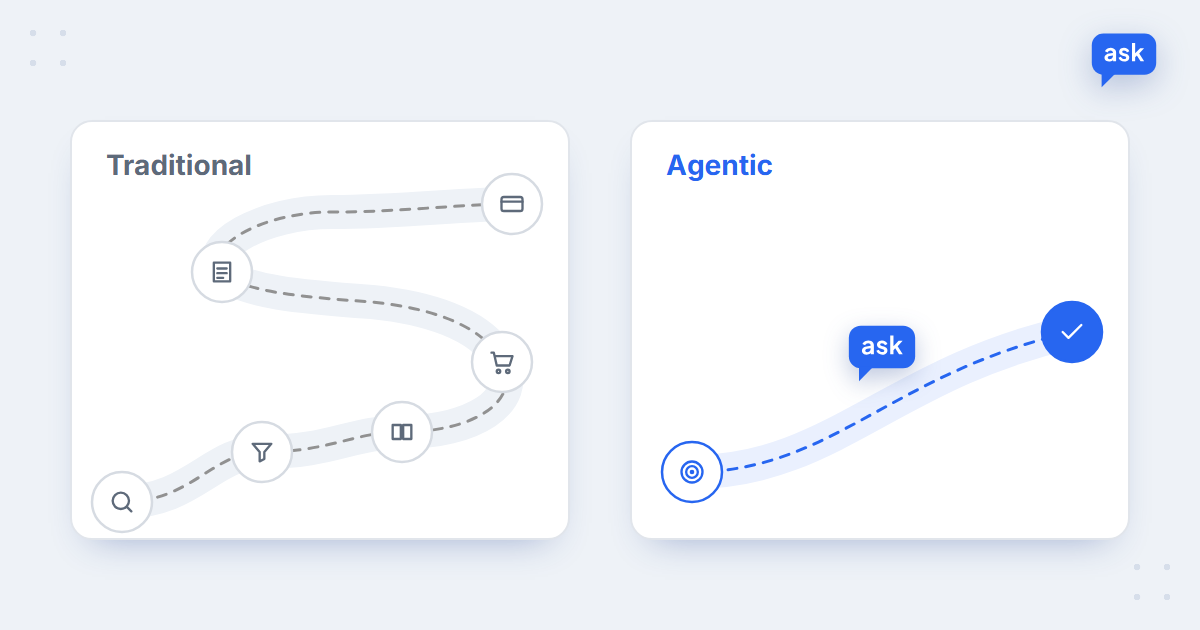
Agentic commerce vs traditional e-commerce
| Traditional e-commerce | Agentic commerce | |
|---|---|---|
| Starting point | A keyword in the search bar | A goal in plain language |
| Finding products | The shopper filters and compares | The agent narrows the catalogue and explains the choice |
| “Will it fit?” | The shopper reads the spec sheet | The agent checks it against product data |
| Cart and checkout | The shopper fills every field | The agent prepares it, the shopper confirms |
| Where the effort sits | With the shopper | With the agent |
| What decides the sale | Page design, search, filters | Data quality and how well the agent answers |
The last row is the important one for a store. When an agent does the browsing, a nice category page matters less than accurate product data, clear policies and an agent that can answer the questions shoppers actually ask.
What is already live in agentic commerce
There is a lot of announcement in this field and less adoption. Here is where the main pieces stand, from the companies’ own pages:
- ChatGPT. OpenAI launched Instant Checkout with an open Agentic Commerce Protocol in September 2025. In March 2026 it said the first version “did not offer the level of flexibility” it wanted and shifted to product discovery: merchants share product feeds, and shoppers usually finish on the store’s own checkout.
- Google. Google introduced the Agent Payments Protocol (AP2) in September 2025 and the Universal Commerce Protocol in January 2026. UCP powers a Buy button in AI Mode and the Gemini app for participating merchants with US listings; the merchant stays the seller of record.
- Card networks. Visa (Intelligent Commerce) and Mastercard (Agent Pay) run programmes that let AI agents pay with tokenised cards. Both are in pilots and early rollouts with selected banks and merchants.
- Stores’ own agents. This is the part that works at scale today, because the store controls the data and the checkout. On morele.net, one of Poland’s largest electronics retailers, the assistant built on AskSpot sets filters, adds to cart and walks the shopper to checkout – see the AI assistant that clicks for your customer.
The pattern so far: AI assistants are becoming a real place where products are discovered, while buying still mostly happens on the store’s own site. For a European store that sells in several countries, Google’s US-only Buy button is not an option yet either – your own site is.
Agentic commerce use cases in an online store
On your own site, an agent earns its place where shoppers get stuck. Four use cases cover most of it:
1. Finding the right product from a description
The shopper describes a need, the agent asks what it still needs to know and recommends specific products from your catalogue, with a reason for each. It searches by meaning, so “something warm for hiking in March” works without the right keyword. More in AI product search and the AI shopping assistant.
2. Checking fit and compatibility
“Will this rack fit my car?”, “does this filter fit my machine?” These questions stop sales more often than price does. The agent checks them against product data instead of sending the shopper to a spec sheet.
3. Filling the cart and preparing checkout
Once the shopper decides, the agent adds the right variant, and in a hands-on setup sets filters, moves to the right category and fills in delivery details – in plain sight, with the option to stop it at any moment. The shopper confirms the payment.
4. Handling the order after the sale
After the purchase, the agent answers “where is my order?” with the real status after the customer confirms the order number and email, and collects the details for a return or change. See order tracking.
 spot
See an AI agent fill a cart on your store
Book a short demo – we’ll show the Agent finding products, checking fit and preparing the cart from your own catalogue.
How to prepare your store for agentic commerce
You don’t need to bet on one protocol to get ready. The same groundwork serves the shopper’s agents and your own:
- Make your product data complete. Sizes, materials, dimensions, compatibility and variants in the product feed, not only in images or free text. Agents can only recommend what they can read.
- Write policies an AI can use. Delivery times, return rules and their exceptions, warranty – stated clearly, on pages and in your knowledge base.
- Keep structured data and feeds current. Product markup on your pages and an up-to-date feed in Google Merchant Center make you readable to AI search.
- Put your own agent on your own site. When a shopper arrives from an AI assistant, they expect to keep talking. An agent on your site answers from your full catalogue and keeps the sale with you.
- Decide what the agent may do. Which steps it can take, where the shopper must confirm, and when it hands over to a person.
- Test before peak season. Run it on real questions before your busiest weeks – the Black Friday AI checklist walks through it.
Risks of agentic commerce – and who is accountable
An agent that acts can also act wrongly. Three risks matter most for a store:
- Wrong answers. An agent that invents a size or a delivery date and then adds the product to the cart turns a bad answer into a bad order. Grounding answers in your own data is the fix – see how to prevent AI hallucinations.
- Consent and payment. The shopper must see what the agent is doing and confirm before money moves. Silent purchases are exactly what payment protocols are designed to prevent.
- Accountability. A Canadian tribunal held Air Canada to a policy its chatbot invented (2024): what a company’s AI says counts as the company’s word. The store remains responsible for what its own agent promises, and – in the protocols above – remains the seller of record for orders placed through AI assistants.
None of this argues against agents. It argues for agents that answer only from your data, work in plain sight and stop at the payment step.
AI assistants are where shoppers start looking. Your own agent is where they can finish buying.
For the wider picture, read what is an AI shopping assistant and AI agent vs chatbot. To see agentic shopping on a live store, read how morele.net uses AskSpot across sales and support, or try the AI Chat Agent on your own catalogue.
FAQ
What is agentic commerce in simple terms?
Shopping where an AI agent does part of the work for you: it searches, compares, fills the cart and prepares the checkout, and you confirm the payment. The agent can be a general AI assistant working for the shopper or the store’s own agent on its website.
What is the difference between conversational and agentic commerce?
Conversational commerce answers and advises in a chat, and the shopper still clicks through the store. Agentic commerce goes a step further: the agent carries out the steps – filters, cart, checkout details – and the shopper confirms. More in what is conversational commerce.
Can shoppers buy directly inside ChatGPT?
Only in limited cases. OpenAI launched in-chat checkout in September 2025 and scaled it back in March 2026 to focus on product discovery; shoppers now usually finish on the store’s own checkout. Google offers a Buy button in AI Mode and Gemini for participating merchants with US listings.
What are AI agents for e-commerce?
AI agents for e-commerce are AI systems that take actions in a store, not just answer: they search the catalogue, check fit, fill the cart, prepare checkout and look up orders. Some work for the shopper across many stores; others run on the store’s own site, like the AI Chat Agent.
Does my store need to join an agentic commerce protocol?
Not to get started. Most protocols are early and limited to certain markets. Complete product data, clear policies, current feeds and your own agent on your own site help with every one of them – and pay off today.
Is agentic commerce safe for shoppers?
It is when the agent answers only from the store’s data, shows every step it takes and stops before the payment for the shopper to confirm. Those three rules are what to look for in any agent – yours or someone else’s.