Key takeaways
- CSAT measures how satisfied a customer was with one interaction; NPS measures how likely they are to recommend the store. They answer different questions, so most stores need both.
- CSAT is the share of 4 and 5 ratings, not the average rating – report it as a percentage and keep the average as a second number.
- Ask one rating question and one open question, right after the moment you want to measure: a chat, a support email, a delivery or a return.
- When AI answers part of the conversations, read the low ratings together with resolution – most one-star ratings sit on conversations that weren’t solved.
- The fastest way to raise CSAT is to fix the answers behind the low scores, not to send more surveys.
What is CSAT?
CSAT (customer satisfaction score) is the percentage of customers who rate an interaction as satisfying – usually a 4 or 5 on a 1–5 scale. You ask one short question right after a chat, a support email, a delivery or a return, and the result tells you how that specific moment went. It is the most common customer service metric because it is simple to ask, simple to calculate and easy to compare week to week.
CSAT is one of three survey metrics stores use. They measure different things, so it helps to know which one answers your question:
| Metric | Question | Scale | What it measures | Best moment to ask |
|---|---|---|---|---|
| CSAT | “How satisfied were you with…?” | 1–5 | One interaction | Right after a chat, ticket, delivery or return |
| NPS | “How likely are you to recommend us to a friend?” | 0–10 | Loyalty to the store | A few weeks after delivery, or once a quarter |
| CES | “How easy was it to get your issue sorted?” | 1–5 or 1–7 | Effort | After a return, a refund or a support case |
For customer service in an online store, CSAT does most of the work: it shows which conversations leave shoppers happy and which don’t. That matters even more once software answers part of them – when an AI customer service agent resolves routine emails and chats, CSAT is how you check that customers are as satisfied with those answers as with your team’s.
How to calculate CSAT
The CSAT formula counts satisfied responses and divides them by all responses:
CSAT = (number of 4 and 5 ratings ÷ total number of ratings) × 100
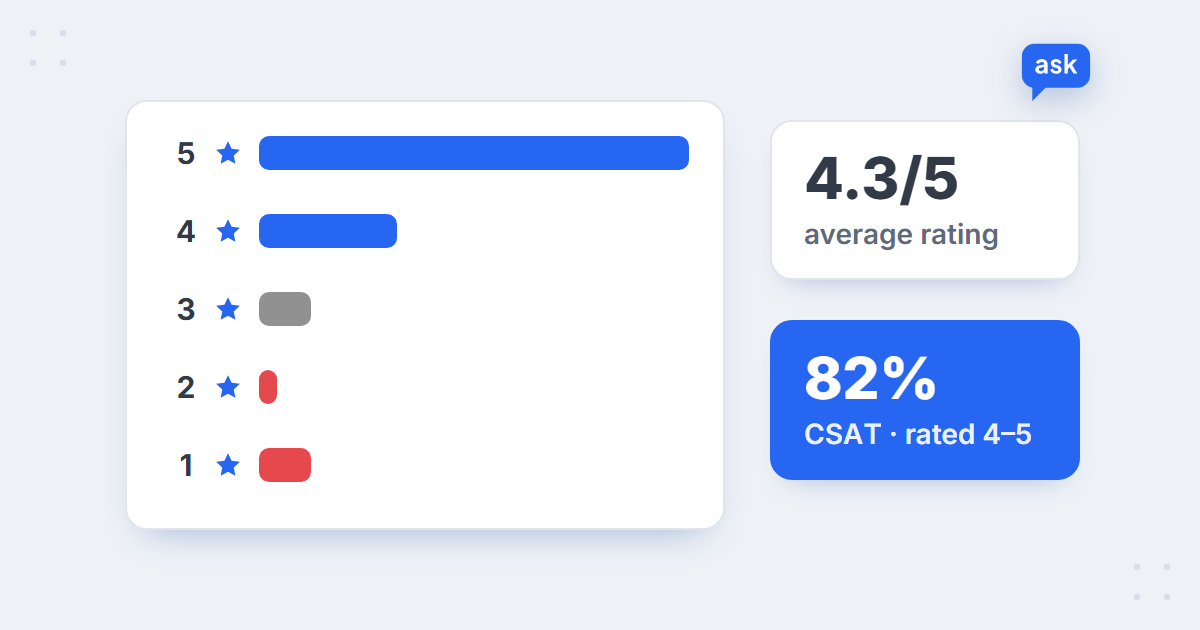
Say 400 shoppers rated a support conversation last month: 250 gave 5 stars, 80 gave 4, 30 gave 3, 10 gave 2 and 30 gave 1. The satisfied responses are 250 + 80 = 330, so CSAT is 330 ÷ 400 × 100 = 82.5%.
The same 400 ratings also give an average rating: (250×5 + 80×4 + 30×3 + 10×2 + 30×1) ÷ 400 = 4.3 out of 5. Many chat tools and review platforms show this average, and it is a useful number – but it isn’t CSAT. An average hides how many people were unhappy: two stores can both show 4.3/5 while one has twice as many one-star ratings as the other. The CSAT percentage keeps the focus on the share of customers you left satisfied.
Report CSAT as a percentage and keep the average rating next to it. The percentage shows how many customers you satisfied; the share of one-star ratings shows how many you lost.
If you use a different scale, count the top part of it as satisfied: 4–5 on a 5-point scale, 5–7 on a 7-point scale, or simply “yes” on a thumbs up/down question. Whatever you choose, keep the same scale everywhere – a 1–5 CSAT and a 1–10 CSAT can’t be compared.
How to calculate NPS
NPS (Net Promoter Score) asks one question – “How likely are you to recommend us to a friend or colleague?” – on a 0–10 scale, and splits the answers into three groups:
- Promoters (9–10) – customers likely to recommend you.
- Passives (7–8) – satisfied, but not enthusiastic.
- Detractors (0–6) – customers likely to tell others to shop elsewhere.
NPS = % promoters − % detractors. The passives count in the total but not in the score, which ranges from −100 to +100. With 500 responses – 260 promoters (52%), 150 passives (30%) and 90 detractors (18%) – NPS is 52 − 18 = 34.
The difference from CSAT is what the score is about. NPS reflects everything a customer has experienced with the store – products, prices, delivery, returns, support – so it moves slowly and is hard to tie to a single change. CSAT is about one interaction, so it tells you which part of the journey to fix. A sensible split for an online store: CSAT after every support contact, delivery and return; NPS a few weeks after delivery or once a quarter.
CSAT survey questions for online stores
A good customer satisfaction survey is short: one rating question about the moment that just happened, and one open question that tells you why. These are ready-to-use CSAT survey questions for the points in an order where satisfaction is won or lost:
| Moment | Rating question | Follow-up question |
|---|---|---|
| After a chat | “How would you rate this conversation?” (1–5) | “What could we have done better?” |
| After a product-advice chat | “Did you find what you were looking for?” (yes / no) | “What were you hoping to find?” |
| After a support email or ticket | “How would you rate the support you received?” (1–5) | “Was your question fully answered?” (yes / no) |
| After delivery | “How satisfied are you with your delivery?” (1–5) | “Is there anything about the delivery we should know?” |
| After a return or refund | “How easy was it to return your item?” (1–5) | “What would have made it easier?” |
| After checkout | “How easy was it to find what you needed?” (1–5) | “Did anything almost stop you from ordering?” |
A few wording rules keep the answers honest:
- Ask about one thing. “How satisfied are you with the product and the delivery?” can’t be answered with one number.
- Keep it neutral. “How satisfied were you…”, not “How much did you enjoy our fast service?”
- Label both ends of the scale – “very dissatisfied” and “very satisfied” – so a 1 and a 5 mean the same to everyone.
- Make the open question optional. Requiring it lowers the number of ratings you get.
- Ask in the customer’s language. If you sell in several countries, a survey in English gets fewer and harsher answers from customers who don’t read it comfortably.
When and where to send a CSAT survey
Timing decides how many people answer and what they’re rating. Ask too late and they rate the whole experience; ask too early and the problem isn’t solved yet.
- Chat – inside the chat window, at the end of the conversation, once the question has been answered.
- Support email – a one-click rating in the reply that closes the ticket, or a short email within a day.
- Delivery – one to three days after the parcel arrives, when the customer has opened it.
- Return or refund – after the money is back, not when the parcel is sent.
- NPS – a few weeks after delivery, or once a quarter for repeat customers.
To avoid survey fatigue, don’t ask the same customer more than one CSAT question per contact, and space NPS surveys out. An in-chat rating gets more answers than an email survey because it costs the shopper one click while they’re still on the page.
What is a good CSAT score?
Benchmarks vary by industry and by how a company asks, so treat them as a range rather than a target. Two public sources give a useful frame: Survicate’s 2025 benchmark of 1,259 CSAT surveys from 370 companies, and the American Customer Satisfaction Index (ACSI) for US online retail.
84%
median CSAT in retail and wholesale
Source: Survicate, 2025
90%
CSAT that puts a company in the top quarter, across industries
Source: Survicate, 2025
79/100
customer satisfaction with US online retailers in 2026
Source: ACSI
In Survicate’s data the median CSAT across all industries is 80%, retail and wholesale sit at 84.2%, and a score of 90% or more puts a company in the top quarter. The ACSI score is a different measure – an index from 0 to 100, not a share of 4 and 5 ratings – so it shouldn’t be compared with CSAT directly. It does show the same picture: online retail is satisfied overall, and the gap between stores is in the details.
For an online store, roughly 80% is a solid CSAT, 85% is good and 90% or more is excellent. Two caveats matter more than the benchmark: compare yourself with your own score over time, and never compare a CSAT percentage with an average rating. Chat ratings are usually reported as an average – at GadziSklep, shoppers rate the AI chat’s help 4.3/5, and at Militaria.pl 4.1/5 – which is a different number from a CSAT percentage.
How to read CSAT when an AI agent answers
Once an AI agent answers part of your chats and emails, CSAT becomes the check on its answers. Ratings on AI conversations behave a little differently from ratings on your team’s, and three patterns are worth knowing before you read the dashboard:
- Few shoppers rate a chat. In the online stores we’ve analysed, typically 5–15% of chat conversations get a rating. That is enough to spot trends, but not enough to judge one week on a handful of scores.
- One-star ratings sit on unresolved conversations. In most stores the one-star ratings line up almost exactly with the conversations the AI couldn’t resolve. A low rating usually means a missing answer, not a rude one – which makes it easy to fix.
- Topics score differently. Order status questions tend to be rated on whether the parcel is on its way; product advice on whether the shopper found the right product. Compare CSAT topic by topic, and AI conversations with your team’s, rather than one blended number.
A rating is a signal, not proof. Read every one- and two-star conversation, find the answer that was missing, and add it – that does more for CSAT than any survey tweak.
To judge how much an AI agent actually solves, pair CSAT with resolution rate – we cover how to measure that, and why vendors’ numbers differ, in deflection vs resolution rate. In AskSpot, the rating of every conversation sits in the analytics dashboard next to resolution, so you can filter the low-rated chats and read them in one place.
Customer service KPIs to track alongside CSAT
CSAT tells you how customers felt; a few other customer service KPIs tell you why. For an online store, five are enough:
| KPI | What it tells you | How to measure it |
|---|---|---|
| CSAT | How satisfied customers are with one interaction | Share of 4 and 5 ratings |
| First response time | How long shoppers wait for the first answer | Seconds in chat, hours in email |
| Resolution rate | How much is solved without a follow-up | Resolved conversations ÷ all conversations |
| After-hours share | How much demand arrives when the team is offline | Conversations outside office hours ÷ all |
| Sales from chat | Whether support also helps customers buy | Orders and revenue that follow a chat |
The after-hours share is the one stores most often underestimate: on the median store in our AI chatbot statistics, 6 in 10 chats arrive outside office hours. If those customers wait until the morning for an answer, CSAT drops long before anyone reads the message.
How to raise CSAT in an online store
Most low scores in an online store come from a few repeat causes: a slow answer, a vague answer about an order, or a customer passed around between people. Five changes fix most of them.
1. Answer when the question is asked
A shopper who asks “is this in stock in size M?” at 22:00 and gets an answer the next morning has usually bought somewhere else. Covering evenings and weekends – with people, an AI agent, or both – removes the most common reason for a low rating. We look at the options in after-hours customer support.
2. Give exact answers about orders
“Where is my order?” is one of the most common support questions in e-commerce, and a vague reply is a quick way to a one-star rating. The answer that satisfies is specific: the status, the courier and the tracking number, after a quick check that the person asking is the customer.
 spot
See which answers your customers rate low
Book a short demo – we’ll show the AskSpot Agent answering your store’s questions, with ratings and resolution side by side in the dashboard.
We explain how the verification and the order lookup work in how AI answers “where is my order?”.
3. Hand over without making the customer repeat themselves
Some conversations need a person – a damaged item, a refund decision, an angry customer. The rating drops when the customer has to explain everything again. A handoff with a summary lets your team pick up where the conversation left off.
4. Tell customers before they ask
A delay announced by the store is forgiven far more easily than one the customer discovers. Proactive messages – about a late parcel, a back-ordered item, a refund on its way – prevent the conversation that would have ended in a low score. More ideas in proactive customer service.
5. Close the loop on every low score
Once a week, read every one- and two-star conversation. Group them by cause, fix the top three – usually a missing answer in the knowledge base, an unclear policy or a slow handoff – and contact the customers you can still win back. For the hardest cases, our guide to handling customer complaints has a step-by-step process and reply examples, and canned responses help your team answer the routine ones consistently.
FAQ
What is the difference between CSAT and NPS?
CSAT measures how satisfied a customer was with one interaction – a chat, a support email, a delivery – on a 1–5 scale. NPS measures how likely they are to recommend the store, on a 0–10 scale, and reflects the whole experience. Use CSAT to fix specific moments and NPS to track loyalty over time.
How do you calculate a CSAT score?
Divide the number of 4 and 5 ratings by the total number of ratings and multiply by 100. For example, 330 satisfied ratings out of 400 give a CSAT of 82.5%.
What is a good CSAT score for e-commerce?
Around 80% is solid, 85% is good and 90% or more is excellent. In Survicate’s 2025 benchmark the median CSAT in retail and wholesale is 84.2%, and 90% or more puts a company in the top quarter across industries. Your own trend over time matters more than any benchmark.
What questions should a CSAT survey ask?
One rating question about the moment that just happened – for example “How would you rate the support you received?” on a 1–5 scale – and one optional open question, such as “What could we have done better?”. Keep the scale the same across all surveys.
Should you send a survey after every chat?
Offer the rating after every chat, but keep it to one click inside the chat window and ask only once per conversation. Email surveys should be spaced out so the same customer isn’t asked more than once per contact.
What is CES (customer effort score)?
CES asks how easy it was to get something done – a return, a refund or a support case – usually on a 1–5 or 1–7 scale. It is useful for processes where effort is the main complaint, such as returns.
CSAT is one part of running customer service with AI. For the full picture – what to automate, what to keep with people and how to roll it out – read our guide to AI customer service for e-commerce.