Key takeaways
- Guided selling leads a shopper to the right product through questions about their needs, instead of making them search the catalogue.
- Quizzes, filters and configurators guide with a fixed script; a person or an AI can follow up on the answer.
- It pays off most where products are hard to compare: fit, size, compatibility and technical specs.
- AI guided selling works only when it answers from your own catalogue and can take the shopper to the cart.
- Start with the categories that bring the most “which one should I buy?” questions, and measure per conversation.
What is guided selling?
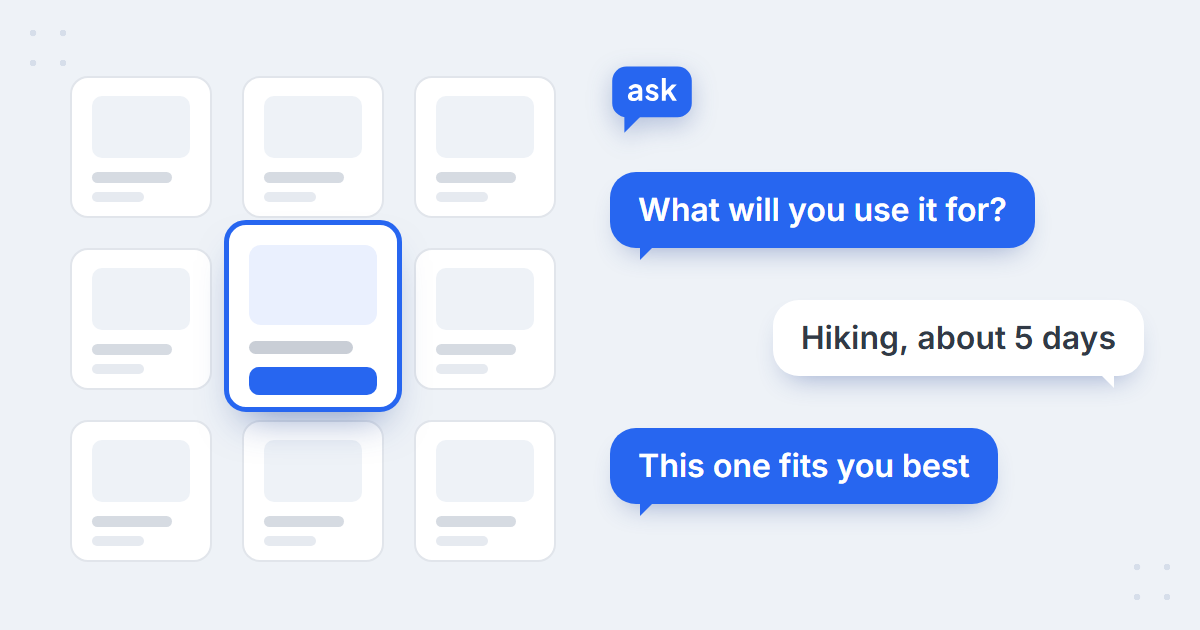
Guided selling is the practice of leading a shopper to the right product through a short series of questions about their needs – what it’s for, who it’s for, what it has to fit – instead of showing them the whole catalogue and leaving them to choose. It is what a good salesperson does in a physical store, and the term is used both in B2B sales and in online retail.
Online, the need for it is easy to see. Across the stores AskSpot runs on, “which one should I buy?” is 28% of chats on the median store, with specs and product features close behind (AI chatbot statistics for e-commerce). These shoppers are not lost – they know what they need, just not which product delivers it. Search and filters can’t answer that, because the answer depends on the shopper’s situation, not on a keyword.
Four ways to do guided selling online
Online stores have tried to guide shoppers for years, with four kinds of tools. Each does part of the job well:
| How it guides | Where it stops | Best for | |
|---|---|---|---|
| Product finder or quiz | A fixed set of questions leads to a short list | Can’t follow up on an unexpected answer; every new product means editing the script | A small, stable range with a few clear choices |
| Filters and configurators | The shopper narrows the range by attributes | The shopper must know which attributes matter and what they’re called | Shoppers who already know their specs |
| A human advisor | Live chat, phone or video with an expert | Only during office hours, and only as many chats as the team can take | High-value, complex purchases |
| AI conversation | Asks follow-up questions and recommends from the catalogue | Has to be grounded in your products, and hands over to a person when it shouldn’t answer | Large catalogues and questions about fit, size or compatibility |
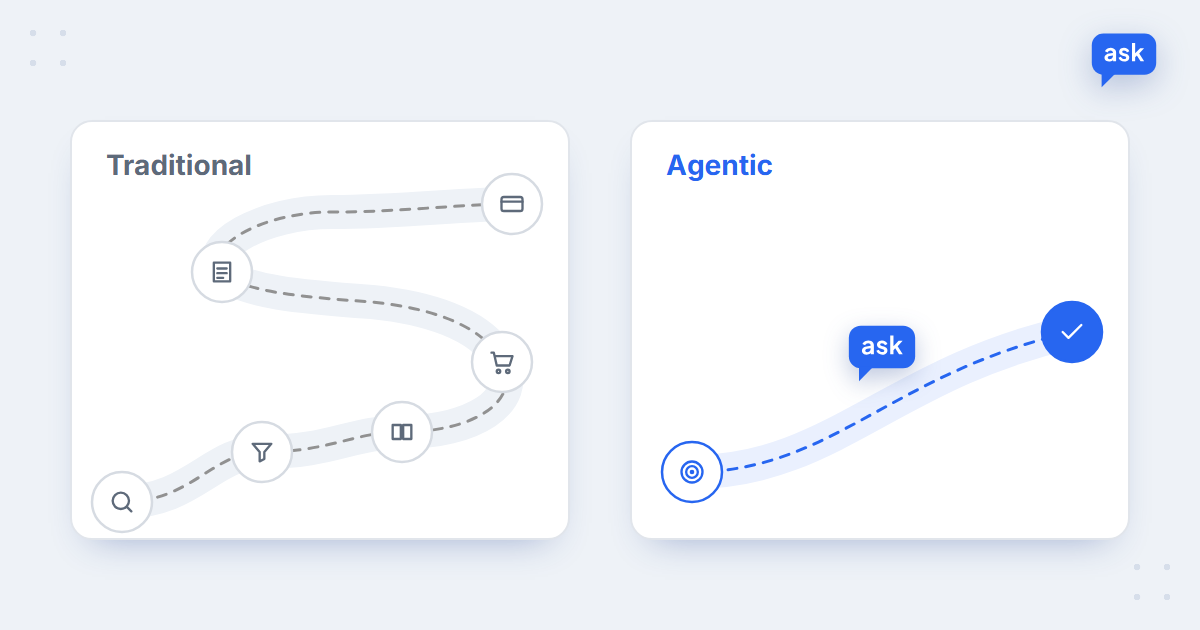
The first two are static: they can’t ask “how wide is the wall?” and then use the answer. That follow-up question is the core of guided selling. We look at where it fits on a single page in high-converting product pages; this article is about guided selling across the whole store.
Guided selling examples by category
Guided selling pays off most where the right product depends on something only the shopper knows. Five stores that run it through an AI chat show the pattern:
Motorcycle parts: checking the fit
A part fits a specific model, year and engine. The shopper asks questions like “which brake pads fit my 2016 bike?”, and the guiding is a fitment check: the agent asks for what’s missing and shows only parts that fit. At Mieloch, a motorcycle parts store, 15.8% of chats end in a purchase.
Terrarium and exotic pets: advice by species
The right lamp, substrate or terrarium depends on the species and the size of the tank – “what heat lamp for a 60 cm terrarium?”. The agent asks about the animal before it recommends. At GadziSklep, a terrarium store, 30.6% of chats add an item to the cart.
Coffee machines and parts: taste and compatibility
Coffee is a taste question, machines and parts are a compatibility question – “which water filter fits my machine?”. The agent handles both from the same catalogue. At Konesso, a coffee retailer, 21.6% of chats end in a purchase.
Footwear: choosing the size
Shoes are bought on fit: foot length, width, how a model runs. The agent asks for the shopper’s usual size and the length of their foot, then answers for the specific model. At Casu, a footwear store, 12.8% of chats end in a purchase.
B2B IT hardware: technical compatibility
Business buyers ask technical questions about networking hardware, servers and software, and the answer depends on what they already run. Senetic, a B2B IT retailer, runs guided selling across seven storefronts in seven languages – more on B2B below.
How AI guided selling works
AI guided selling is an AI agent that holds the guiding conversation in the shopper’s own words. In an AI chat agent for e-commerce it runs in four steps:
- Understand the need. The shopper describes the problem, not an attribute: “a tent for two, hiking in Scandinavia in September”.
- Ask what’s missing. One or two follow-up questions – weight, budget, the model it has to fit.
- Recommend from the catalogue. Specific products from your store, with the reason each one fits – found by meaning, not keywords (AI product search).
- Take the next step. Product cards with an add-to-cart button, or the answer to the last question that stops the order.
Some stores go one step further and let the agent work on the page itself – opening the right category, ticking the filters and pointing out the best product, as in the AI assistant that clicks for your customer.
 spot
See guided selling on your own catalogue
Book a short demo – we’ll run the Agent on real questions about products from your store.
What guided selling does to sales
When the guiding conversation ends in a product the shopper trusts, a large share of chats turn into carts and orders. Three published examples:
30.6%
of chats add an item to the cart in a terrarium store
AskSpot Case Studies
21.6%
of chats end in a purchase at a coffee retailer
AskSpot Case Studies
15.8%
of chats end in a purchase in a motorcycle parts store
AskSpot Case Studies
The stores are GadziSklep, Konesso and Mieloch – linked in the examples above. These are single-store figures, not averages; what you get depends on your catalogue and how many of your shoppers need help choosing.
Guided selling doesn’t add a step to the purchase. It removes the one where the shopper leaves to research elsewhere.
Guided selling in B2B
The term comes from B2B sales, where products are technical, buyers ask about compatibility with what they already run, and a wrong order is expensive. The same questions now arrive online, often outside the sales team’s hours. At Senetic, the agent answers technical questions about networking hardware, servers and software across seven storefronts and seven languages – with €215,300 a month in chat-driven orders. If your catalogue feels “too technical for a chatbot”, that is the case to read.
How to choose a guided selling tool
Whether you compare quiz builders, configurators or AI agents, check these eight things:
- It reads your catalogue. It syncs from your product feed, so new products and prices don’t mean rewriting a script.
- It asks follow-up questions. It can react to an answer it didn’t expect.
- It checks fit and compatibility from the specs. Not just “here are some products”, but “this one fits your model”.
- It only recommends what you sell. Answers come from your catalogue, never from the open web.
- It leads to the cart. Product cards and add to cart in the conversation.
- You can steer it. Rules for which products to prioritise and how to advise.
- It hands over to a person. For the questions it shouldn’t answer, with the conversation passed on.
- It speaks your shoppers’ languages and reports what they ask. So you can see where shoppers get stuck.
How to roll out guided selling in five steps
- Pick the categories that need it most. Start where shoppers ask “which one?” and “will it fit?” – your chat logs or support inbox will show you where.
- Connect your product feed. Specs, dimensions and compatibility data are what the agent advises from; gaps in the feed become gaps in the advice.
- Set your recommendation rules. Which products to prioritise, which accessories to suggest, when to ask before recommending.
- Offer help where shoppers hesitate. A short, page-specific greeting on product and search pages – examples in chat greeting examples for online stores, set up with proactive messages.
- Measure per conversation. How many chats with a recommendation end in a click, a cart and an order – and read the conversations that didn’t.
For a wider look at AI shopping tools, see what an AI shopping assistant is and our roundup of e-commerce AI chatbots.
FAQ
What is guided selling?
Guided selling leads a shopper to the right product through a short series of questions about their needs – what it’s for, who it’s for, what it has to fit – instead of showing the whole catalogue. Online, it is done with product finders, configurators, live advisors or an AI conversation.
What is AI guided selling?
Guided selling done by an AI agent: the shopper describes their need in their own words, the agent asks follow-up questions and recommends specific products from the store’s catalogue, with an add-to-cart button in the conversation.
What is the difference between guided selling and product recommendations?
Product recommendations show items based on behaviour, such as “customers also bought”. Guided selling asks the shopper about their need first and recommends based on the answer – so it can explain why a product fits. More in AI product recommendations.
Is guided selling only for B2B?
No. The term comes from B2B sales, but it works in any store where shoppers need help choosing – parts that must fit, clothes and shoes that must fit, technical products and large catalogues.
How do you measure guided selling?
Per conversation: the share of chats with a recommendation that end in a product click, the share that add to cart, and the share that end in a purchase. Read the conversations that didn’t convert to find missing products or data.