Key takeaways
- The standard product-page checklist – images, copy, reviews, delivery info, a clear call to action – is necessary, but it only serves shoppers who have already decided.
- A large share of pre-purchase questions are about choosing, specs and fit – questions a static page can’t answer for one specific shopper.
- Filters, quizzes and comparison tables narrow the choice, but none of them can ask the shopper a follow-up question.
- Guided selling on the product page – a short conversation grounded in your own catalogue – closes that gap in the moment.
What makes an ecommerce product page convert?
A high-converting product page is one that removes every reason a ready shopper has to hesitate. The usual checklist is well known, and most stores already follow it:
- clear, zoomable images and, where it matters, video;
- a description that leads with benefits and keeps the full specs one click away;
- reviews and ratings close to the price;
- delivery time, delivery cost and the returns policy stated up front;
- one obvious add-to-cart button, visible on mobile without scrolling.
Every one of these is worth doing. But look at what they have in common: they all describe this one product, to a shopper who has already decided it’s probably the one. They make a yes easier. They don’t help anyone get to a yes.
The question the checklist doesn’t answer: “which one is right for me?”
A lot of shoppers who land on a product page aren’t evaluating that product. They are choosing. They arrived from a category page or an ad with three similar items in mind, and the question in their head isn’t on any page: “Will this sofa fit a 250 cm wall?”, “Is this the right filter for my machine?”, “Which of these two is better for a beginner?”
The page can’t answer those, because the answer depends on the shopper’s own situation – their room, their car, their skin type, their budget. In a physical shop this is the moment a good salesperson steps in, asks one question and points at the right shelf. Online, the shopper opens five tabs, reads reviews that don’t quite match their case, and very often leaves without deciding.
A product page is written once, for everyone. The question that blocks the sale is asked by one shopper, about their own situation.
What shoppers actually ask before they buy
We can measure this directly. Across more than 240,000 shopper conversations in 15 e-commerce categories handled by AskSpot’s AI Chat Agent, we tagged what people ask before they buy. In most categories, pre-purchase questions are the majority of all chat – 86% in home and furniture, 87% in automotive, 90% in garden and outdoor. And within those pre-purchase conversations, three kinds of question dominate:
up to 32%
of pre-purchase chats ask for help choosing – “which one should I buy?”
AskSpot Internal Data · 48 stores
up to 35%
of pre-purchase chats ask about specs and dimensions
AskSpot Internal Data · 48 stores
up to 20%
of pre-purchase chats ask “will it fit?”
AskSpot Internal Data · 48 stores
The mix depends on what you sell. Choosing leads in consumer electronics (28% of pre-purchase chats) and automotive (32%) – shoppers know the category but not the model. Specs lead in furniture (33%) and garden (35%), where width, depth and materials decide the purchase. Compatibility is the automotive signature at 20%, against 8% in electronics: “will this part fit my car?” is a question a product page can only answer with a fitment table most shoppers won’t read.
Fashion, beauty and books ask a different first question. There, delivery and purchase terms lead the pre-purchase mix (26–44%), with help choosing and specs close behind – 18% each in fashion. Those questions get answered in the chat too: “does this run small?” or “will it arrive by Friday?” – and fashion shoppers who chat convert well, with 12.7% of chats ending in a purchase across three fashion stores.
Why filters, quizzes and FAQs only get halfway
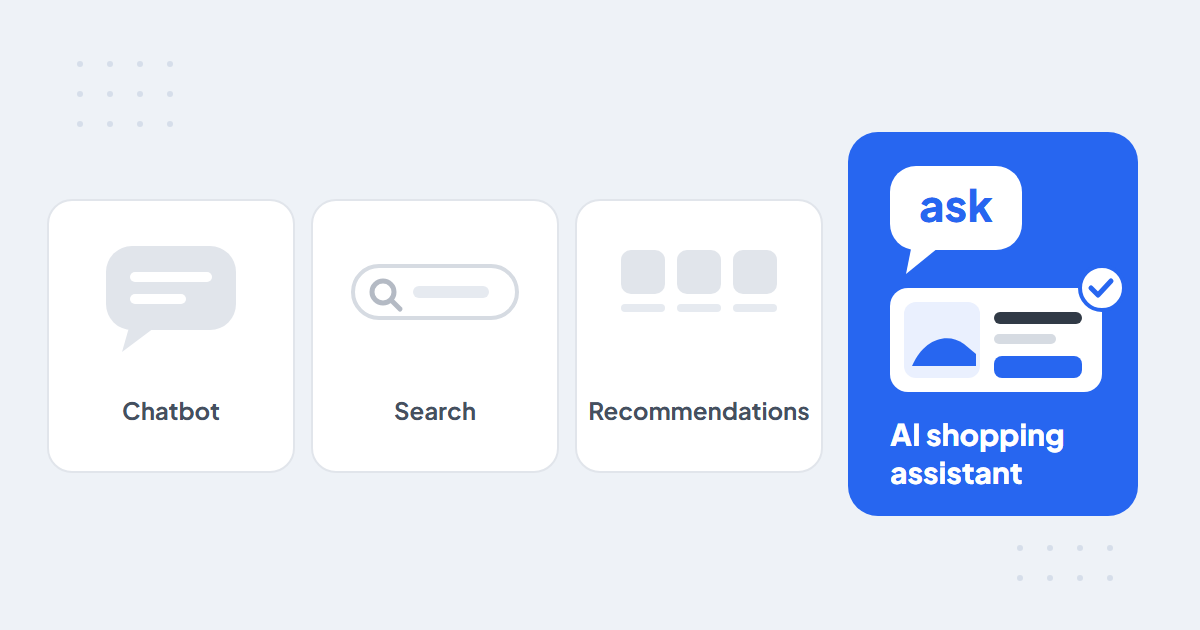
Stores have tried to answer the choosing question without a person for years. Each of the common tools does part of the job well:
- Filters and a product finder narrow a category fast – if the shopper already knows the attributes that matter and what they’re called.
- A product recommendation quiz asks questions, but a fixed set: it can’t follow up on an unexpected answer or handle the shopper whose case isn’t on the list.
- Comparison tables lay out the differences, then leave the shopper to work out which difference matters to them.
- Product FAQs answer the questions someone predicted, not the one this shopper is asking.
What these have in common is that they are static. They can’t ask “how wide is the wall?” and then use the answer. That follow-up question is the core of guided selling – the practice of leading a shopper to the right product through a short series of questions about their needs – and it’s exactly the part online stores have been missing.
Guided selling on the product page: answering in the moment
Guided selling in e-commerce now usually means an AI agent that holds that short conversation on the page, in the shopper’s own words. The shopper types the problem rather than an attribute; the agent asks what it needs to know, then answers from your catalogue with specific products, not a category link. With proactive messages, it can also offer help to a shopper who lingers on a product page, instead of waiting to be asked.
Two things make this work rather than annoy. First, the agent must be grounded in only your products – their specs, dimensions and stock status, from a regular sync of your catalogue (daily by default) – so every recommendation is something you actually sell. Second, it has to search by meaning, not keywords: AI product search turns “a sofa for a small living room with the chaise on the left” into a filter on width, layout and chaise side.
 spot
spotSee it on your own product pages
Book a short demo – we’ll show the Agent answering questions about products from your store.
What answering the question does to conversion
When the choosing question gets a specific answer, a large share of those conversations end in a sale. On Konesso, a specialty coffee store, 21.6% of chats end in a purchase and 29.1% add something to the cart – shoppers ask which beans suit their taste or which water filter fits their machine, and get a product back. On Edinos, a furniture store with a 36,000-product catalogue, the Agent turns “my alcove is 134 cm” into a specific unit, and 15.2% of chats add to cart.
One honest caveat: these are purchase rates among shoppers who chatted, not the store’s overall conversion rate, and shoppers who start a conversation are already engaged. The point isn’t that a chat window lifts every visitor. It’s that the shoppers stuck on “which one?” – the ones the checklist can’t reach – convert well once someone answers them.
The checklist makes a yes easier. Answering the shopper’s own question is what gets them to the yes.
A product-page checklist that includes the question
Keep the standard elements, and add the part that serves the undecided shopper. A product page built for both kinds of visitor does the following:
- Shows the specs that decide the purchase in your category – dimensions for furniture, compatibility for parts, size and fit for fashion – near the top, not in a tab.
- States delivery time, cost and returns before the shopper has to ask.
- Lets the shopper ask their own question on the page, in their own words, without leaving it.
- Answers with specific products from your catalogue – including a closer alternative when this one isn’t right.
- Asks a follow-up question when the answer depends on the shopper’s situation.
- Works after hours and in the shopper’s language, when no one from your team is there to answer.
- Hands over to a person when the question isn’t one the agent should answer.
The last five points are what an AI shopping assistant on the product page is for, and AI product discovery on your own store explains why the conversation should stay on your catalogue rather than move to a general AI. For the wider picture of how conversation lifts sales, see how AI increases conversion in e-commerce.
FAQ
Can AI answer product questions before customers buy?
Yes. An AI agent grounded in your product catalogue can answer pre-sale questions about specs, dimensions, compatibility and which product suits a given need – and reply with specific products from your range. It works from your own product data, so it answers about what you sell, not about products in general.
How do you give shoppers instant answers without them leaving the page?
Put the answer on the product page itself: a chat agent the shopper can ask in their own words, which replies within seconds and shows matching products inside the conversation. The shopper never has to open another tab, email support or wait for opening hours.
What is guided selling in e-commerce?
Guided selling is leading a shopper to the right product through a short series of questions about their needs, the way a good salesperson does in a shop. Online it used to mean fixed quizzes and product finders; today it increasingly means an AI agent that asks follow-up questions and recommends from the store’s own catalogue.
Will an AI agent recommend products I don’t stock?
Not if it’s grounded in your catalogue. A grounded agent answers only from your own products, synced from your feed (daily by default), so it can’t suggest a competitor’s item. When you don’t carry what the shopper asks for, it offers the closest product you do have.