Key takeaways
- Conversational AI is software that understands questions in natural language, keeps track of the conversation and replies like a person would – increasingly with large language models underneath.
- In e-commerce, what makes it useful is grounding: answers come from your catalogue, policies and order data, not from what the model happens to know.
- On the median store in our data, 74% of chats are pre-purchase and the AI resolves 77% of them with no human.
- Good conversational AI is defined as much by what it refuses to do – guess a fit, give medical advice – as by what it answers.
- Platforms fall into three groups: build-it-yourself toolkits, helpdesk suites with an AI layer, and e-commerce-native agents.
What is conversational AI?
Conversational AI is technology that lets people talk to software in their own words – typed or spoken – and get a relevant, human-sounding reply. It understands what someone means rather than matching keywords, remembers what was said earlier in the conversation, and can look things up or take actions on the person’s behalf.
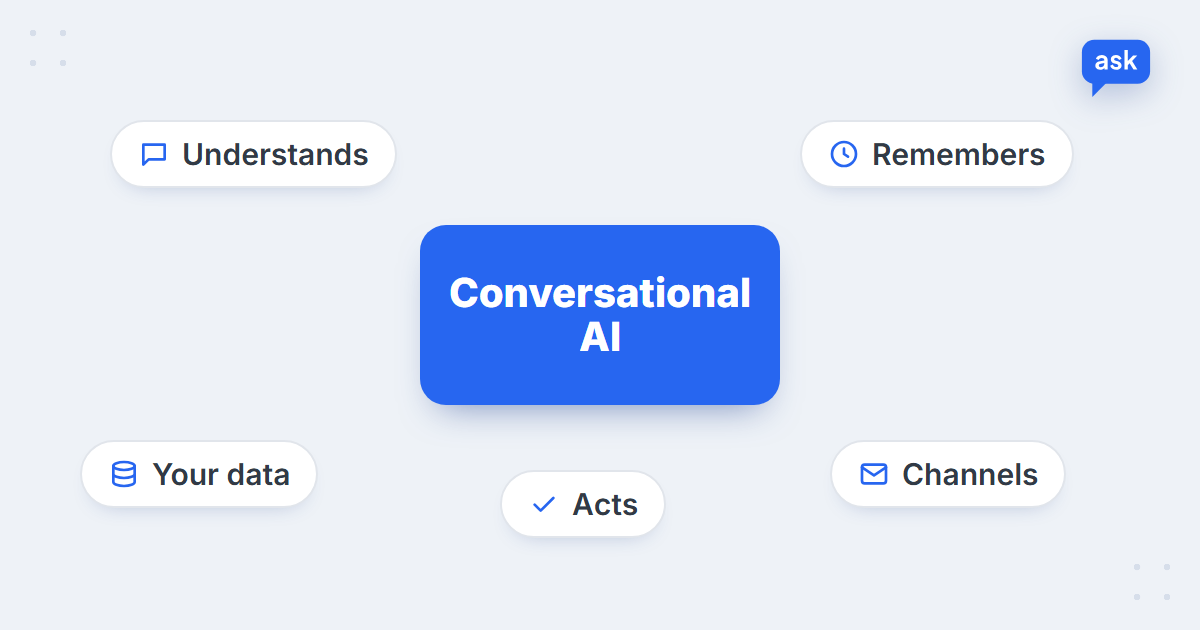
Under the hood, a conversational AI system in an online store has five building blocks:
| Building block | What it does | In an online store |
|---|---|---|
| Language understanding | Works out what the person means, in any wording or language | “Something warm for a toddler in winter, under €50” is understood as a product search with filters |
| Conversation memory | Keeps the context of the whole conversation | “And in blue?” refers to the jacket from two messages ago |
| Grounding in your data | Answers from trusted sources instead of the model’s general knowledge | Catalogue, prices, stock, shipping and returns policies, order data |
| Actions | Does something, not just says something | Shows products, adds to cart, looks up an order, records a cancellation |
| Channels | Meets the person where they are | Website chat, support email, marketplace messages, a shopping app |
Older chatbots had only the first block, and a weak version of it: they matched keywords to a script. Large language models changed the first two blocks almost overnight. The other three – grounding, actions and channels – are where conversational AI platforms still differ most, and they decide whether the system is useful in a store.
How conversational AI works in an online store, step by step
Take a simple question in the chat on a store’s website. Behind the reply there are five steps:
- Understand. The shopper asks for wireless headphones under a set budget. The AI recognises a product search, a category and a price limit.
- Look it up. It searches the store’s own catalogue – the AI product search reads names, specs and descriptions, not just keywords. In AskSpot the catalogue is synced daily, and policies come from the store’s knowledge base.
- Answer. It writes a reply in the shopper’s language and shows matching products as cards.
- Act. On request it adds an item to the cart – or, after the sale, checks an order once the shopper confirms their order number and email.
- Hand over when needed. If the case needs a person, it passes the conversation to the team with a summary, so nobody has to start again.
 spot
The step that matters most is the second one. A language model on its own will happily invent a product, a price or a returns window that sounds right. Conversational AI in a store is only as reliable as the data it answers from and the rules about when not to answer – more on that in how to prevent AI hallucinations in e-commerce.
Conversational AI vs chatbot vs AI agent
The three terms overlap, and vendors use them loosely. A practical way to tell them apart:
| What it is | What it can do in a store | |
|---|---|---|
| Chatbot | A program that replies in a chat, often from fixed scripts or decision trees | Answers a set list of questions; anything off-script ends in “I don’t understand” |
| Conversational AI | The technology for understanding and generating natural conversation | Understands any wording and language, keeps context, sounds natural |
| AI agent | Conversational AI connected to your data and tools, with a goal | Advises from the catalogue, checks orders, adds to cart, records requests |
In other words, conversational AI is the capability; a chatbot is one (often limited) use of it; an AI agent is the version that can actually finish a task. We compare the last two in detail in AI agent vs chatbot.
Types of conversational AI platforms
“Conversational AI platform” covers very different products. For an online store they fall into three groups:
| Type | Examples | Best for | What you supply |
|---|---|---|---|
| Build-it-yourself toolkits | Google Dialogflow, Amazon Lex, Rasa | Companies with developers building a custom assistant | The conversation design, integrations with your store and helpdesk, hosting and ongoing maintenance |
| Helpdesk suites with an AI layer | Intercom Fin, Zendesk’s AI agents, Gorgias | Support teams already running on that helpdesk | The helpdesk itself, a help-centre to answer from, and setup of store integrations |
| E-commerce-native agents | AskSpot and other specialist tools | Online stores that want selling and support from one agent | Your product feed, policies and order connection – the agent is built around them |
The trade-off is control versus time. A toolkit lets you build anything, but you also build everything – the catalogue search, the order lookup, the guardrails. A helpdesk AI layer is strongest on support tickets inside its own helpdesk. An e-commerce-native agent starts from the catalogue and the order, so it can sell before the purchase and support after it. For side-by-side comparisons with specific tools, see our comparison pages.
What shoppers actually ask conversational AI
Our AI chatbot statistics cover 205,731 chats handled by AskSpot agents on European online stores in one month. They show what conversational AI is really used for in e-commerce – and it isn’t small talk:
74%
of chats are pre-purchase on the median store
AskSpot Internal Data
77%
of chats resolved by AI with no human on the median store
AskSpot Internal Data
8.3
messages per chat on the median store
AskSpot Internal Data
Shoppers use conversational AI the way they would use a good sales assistant: about four questions per chat, mostly about which product to choose. The most common topics on the median store:
| Topic in chat | Median store | Highest store |
|---|---|---|
| Finding a product and advice – “which one should I buy?” | 28% | 39% |
| Specs and product features | 25% | 39% |
| Purchase and delivery terms | 10% | 27% |
| Asking for a person | 6% | 22% |
| Order status | 5% | 30% |
| Compatibility and fit – “will it fit my car?” | 5% | 36% |
Two details are worth noting. The mix follows the catalogue: compatibility is a footnote for most stores but up to a third of chats on car and motorbike parts stores. And shoppers don’t only type – about 1 in 35 chats includes a voice message, on every store in the group. A conversational AI that can’t handle both loses part of the conversation.
What stores have learned: guardrails matter as much as answers
Our case studies show the same pattern from three different angles. The value of conversational AI comes from answering the right questions well – and from knowing where its answers stop:
- Fit, answered from the catalogue – not guessed. Carmager sells made-to-measure car accessories in 12 country storefronts. “Will these mats fit my car?” arrives in every market, and the agent answers it from the same catalogue data the product pages are built on – so the answer is the store’s, not the model’s. The result: 72% of chats resolved.
- Languages without a team per market. Mamabrum serves customers in 20 languages with one team. The agent detects the shopper’s language and runs the conversation as if the store were local – 13 shopper languages appeared in a single month, all answered by the same agent.
- Knowing when not to answer. At SFD, a supplements store, some questions are health-adjacent. Where a question turns medical, the agent says so and points to a specialist rather than guessing – while still turning 26% of chats into cart-adds.
When you test a conversational AI platform, don’t only ask questions it should answer. Ask the ones it shouldn’t – a fit it can’t confirm, a medical question, a discount that doesn’t exist – and see what it does.
See conversational AI on your own catalogue
Book a short demo – we’ll show AskSpot answering questions about your products and orders, in your customers’ languages.
How to choose a conversational AI platform for e-commerce
Demos of conversational AI all sound impressive – language models make every tool sound fluent. The differences show up in what sits around the model. Check that the platform:
- answers from your catalogue and order data, not only from a help-centre, so it can recommend real products and talk about a specific order;
- takes actions – shows products, adds to cart, records requests – rather than only replying;
- covers the channels you use: website chat, support email, marketplace messages, a mobile app;
- answers in your customers’ languages – see multilingual support;
- hands over to a person cleanly and lets you review answers first in a test or draft mode;
- keeps your data yours – ask whether your conversations are used to train third-party models (in AskSpot they aren’t);
- reports on resolution and sales, not just conversation counts;
- is priced in a way that fits your volume – per conversation, per resolution or per seat changes the bill a lot. AskSpot charges per conversation; see pricing.
For the support side of the decision – what to automate and how to measure it – see our guide to AI customer service for e-commerce.
Build or buy?
With today’s language models it is tempting to build your own. The model is the easy part; the catalogue search, order integrations, languages, guardrails, analytics and maintenance are where the time goes – and they keep needing work as your store changes. We run the numbers in AI chatbot cost: build vs buy. If you’d rather try a ready agent on your own catalogue first, AskSpot has a 7-day free trial.
FAQ
What is conversational AI in simple terms?
It is technology that lets people talk to software in their own words and get a natural, relevant reply. It understands meaning rather than keywords, remembers the conversation, and – when connected to data and tools – can look things up and take actions.
Is ChatGPT conversational AI?
Yes – ChatGPT is a general-purpose conversational AI. On its own, though, it doesn’t know your products, prices, stock or orders. Conversational AI for a store connects a language model to that data and limits it to answers it can support.
What is the difference between conversational AI and generative AI?
Generative AI is the broader family of models that create text, images or other content. Conversational AI is about dialogue – understanding a person and replying across a conversation. Modern conversational AI usually uses generative AI to write its replies.
What are examples of conversational AI in e-commerce?
A chat that recommends products from the catalogue and adds them to the cart, an assistant that checks whether a part fits a specific car, an agent that answers “where is my order?” from live order data, and an inbox agent that replies to support emails in the customer’s language.
Does conversational AI make things up?
A language model on its own can. That’s why conversational AI for a store should answer only from your catalogue, policies and order data, and hand over to a person when it can’t confirm an answer. See how to prevent AI hallucinations.
Conversational AI is the technology; what a store does with it is commerce. For how stores sell through conversation – and where agentic commerce takes it next – read what is conversational commerce.