Key takeaways
- Conversational commerce means buying and getting help through a dialogue – on the store’s website, in its app or in a messaging channel.
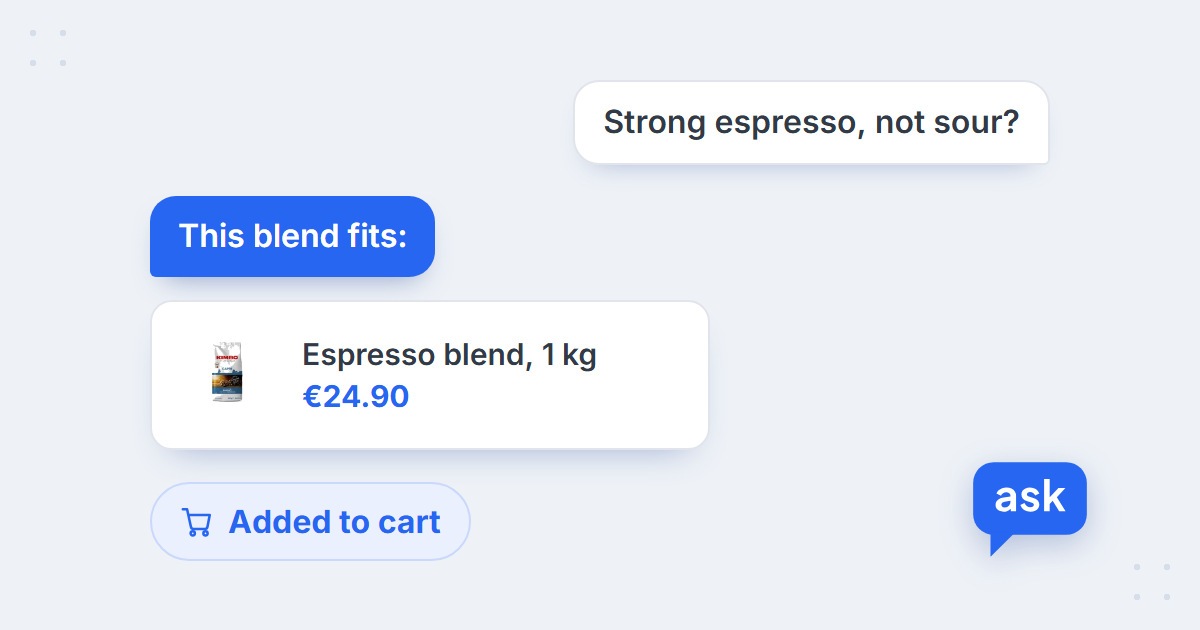
- What makes it commerce, not just chat: answers come from the store’s own catalogue, and the conversation can end with a product in the cart.
- On the median store AskSpot runs on, 20% of chats add an item to the cart and 10% end in a purchase.
- Agentic commerce is the next step: the agent carries out the steps for the shopper – up to the order waiting for payment confirmation.
- For a store, the point is to keep that conversation on its own site, grounded in its own products.
What is conversational commerce?
Conversational commerce is the use of conversation – chat, messaging or voice – to help customers find, choose and buy products, and to look after them after the purchase. Instead of clicking through categories and filters, the shopper asks: “I need a gift for a coffee lover, up to €50”, and gets two or three matching products with a reason for each.
Two things separate it from a contact form or a FAQ bot. The answers come from the store’s own data – products, prices, stock, policies and orders. And the conversation leads somewhere: to a product page, to the cart, to an answer about a parcel. A chat that can only say “please contact our team” is customer service, not commerce. For how AI agents differ from scripted chatbots, see AI agent vs chatbot.
| Classic online store | Conversational commerce | |
|---|---|---|
| How the shopper finds a product | Categories, filters, keyword search | Describes the need in their own words |
| Product advice | Product descriptions and reviews | Answers to the shopper’s own questions |
| Getting to the cart | Product page → add to cart | From the conversation, with the right variant |
| After the purchase | Email or contact form | The same chat answers “where is my order?” |
Where conversational commerce happens
- Chat on the store’s website. The most common form: a chat window on product, category, search and cart pages. It sits where the buying decision is made.
- Chat inside the store’s mobile app. For stores with their own apps this is often the bigger channel – at PHH Group, 43% of all conversations happen in the native apps.
- Messaging apps and voice. Some brands also sell through messaging apps or voice assistants. These are channels of their own, with their own rules.
- The support inbox. Email and marketplace messages are conversations too – mostly after the purchase, about orders, deliveries and returns.
AskSpot works in the first two and in the last one: the AI Chat Agent on the website and in mobile apps, and the AI Inbox Agent in the support inbox.
What a conversational commerce platform does
A conversational commerce platform is the software that runs these conversations for the store. Whatever the vendor, the ones worth paying for do five jobs:
- Answers from the catalogue. Specs, sizes, compatibility, stock and price – from the store’s own product data, not from general knowledge (AI product search).
- Recommends. Asks one or two questions, then suggests a short list with a reason for each (AI product recommendations).
- Adds to the cart. The right variant goes into the cart from the conversation, so the shopper doesn’t have to find it again (AI shopping assistant).
- Answers about orders. Looks up the order and answers “where is my parcel?” in the same chat (order tracking).
- Hands over to a person. When the case needs one – with the conversation summarised, so the customer doesn’t repeat themselves (human handoff).
The first three are the commerce part; the last two keep the same conversation going after the sale. For the step-by-step sales method behind jobs 1–3, see guided selling in e-commerce.
Conversational commerce examples
Four stores where the conversation is part of how they sell – each with a figure from its published case study.
Konesso – coffee chosen by taste, machines by fit
A specialty coffee store: shoppers describe the taste they like, or ask which water filter fits their machine. The agent answers both from the catalogue – and 1 in 5 chats ends in an order (21.6%). Read the Konesso case study.
Senetic – technical B2B questions in seven storefronts
A distributor of IT and networking hardware. The questions are about ports, PoE and compatibility – the kind a filter can’t answer. 19.5% of these chats end with a product in the cart. Read the Senetic case study.
Ogrodosfera – big-ticket garden products bought on specs
Pergolas, carports and garden furniture across nine European markets. Shoppers ask about dimensions, materials and wind ratings before they spend thousands – and the chat drives €412,000 a month in orders. Read the Ogrodosfera case study.
PHH Group – marketplaces, websites and native apps
Multi-category marketplaces in Lithuania, Latvia, Estonia and Finland. The same agent runs on the websites and inside the apps, where 43% of conversations happen – in four local languages, and for nearly one shopper in five, in Russian. Read the PHH Group case study.
Does conversational commerce increase sales?
Pooled across the stores AskSpot runs on, the median store sees 20% of chats add an item to the cart and – on stores that track orders back to the chat – 10% end in a purchase. Of the shoppers shown products in the chat, 47% click at least one. These are real consultations, not one-line lookups: a chat runs to 8.3 messages on the median store. Full data and method: AI chatbot statistics for e-commerce.
 spot
See conversational commerce on your store
Book a short demo – we’ll show the agent answering questions about your own products.
From conversational to agentic commerce
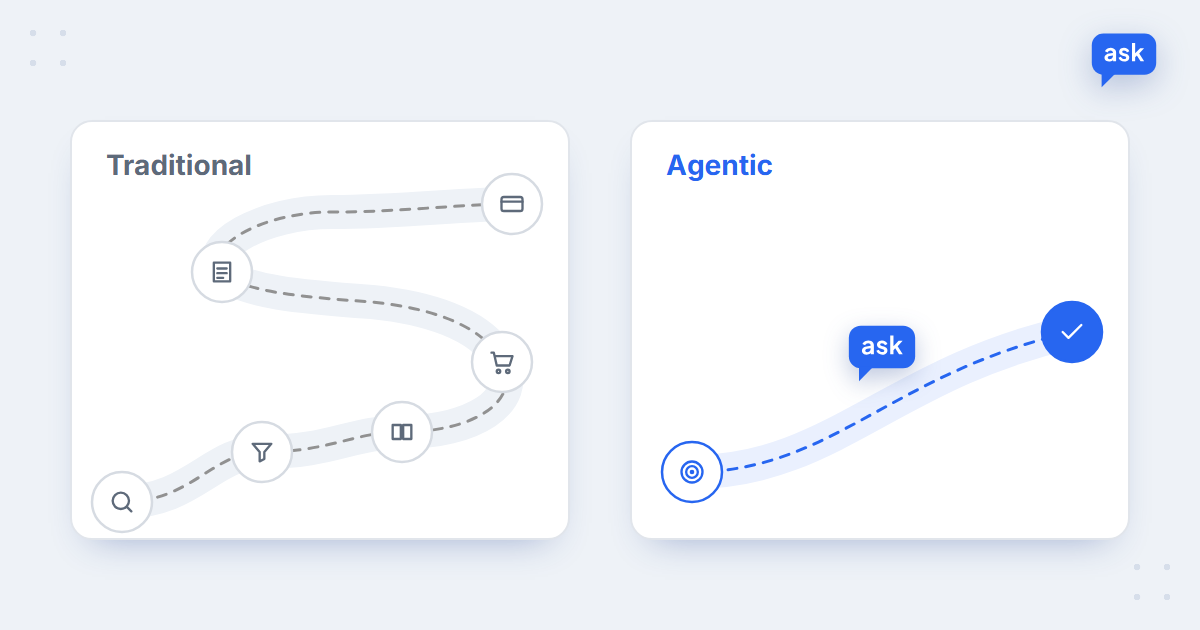
Conversational commerce answers and advises; the shopper still does the clicking. Agentic commerce is the next step: an AI agent that carries out the steps for the shopper. Given a goal – “find a bike for a 7-year-old and order it to my address” – it picks the product, fills the cart, sets delivery and payment, and stops at the one step the shopper has to take: confirming the payment.
That isn’t a forecast. On morele.net the assistant already works this way – see the AI assistant that clicks for your customer.
Conversational commerce: the agent tells the shopper where to click. Agentic commerce: the agent clicks – and the shopper confirms.
Agentic commerce vs traditional e-commerce
| Traditional e-commerce | Conversational commerce | Agentic commerce | |
|---|---|---|---|
| The shopper | Searches, filters, compares | Asks and gets advice | Gives a goal |
| The store | Shows pages | Answers and suggests | Carries out the steps |
| The cart | Filled by the shopper | Filled from the conversation | Filled by the agent |
| Checkout | Shopper fills in every field | Shopper fills in every field | Prepared by the agent, confirmed by the shopper |
Your agent or someone else’s
“AI shopping agents” also means assistants outside your store – general AI chat tools that help shoppers compare and pick products across the web. For a store, the question is where that conversation happens. On your own site, the agent knows your catalogue, your stock and your policies, and the sale stays yours. That argument in full: own the AI buying moment on your own store. For the two kinds of agent, the journey from discovery to transaction and what is live today, read what is agentic commerce.
How to start with conversational commerce
- Start where the questions are. Product pages, search and the cart – the places where shoppers hesitate.
- Connect the catalogue first. Without product data, a chat can only talk; with it, it can sell.
- Add order data. So the same conversation can answer after the purchase.
- Decide on the handoff. Who takes over during service hours, and what happens after hours.
- Measure sales, not chats. Cart-adds and purchases from conversations, not the number of messages.
Weighing it against a team on live chat? See live chat vs AI chat.
FAQ
What is conversational commerce?
Conversational commerce is selling and serving customers through conversation – chat, messaging or voice – instead of menus, filters and forms. The shopper describes what they need, and the store answers with products from its own catalogue, adds them to the cart and answers questions about orders.
What is a conversational commerce platform?
Software that runs these conversations for a store. A good one answers from the store’s product data, recommends products, adds them to the cart, answers order questions and hands over to a person when needed.
What is agentic commerce?
Agentic commerce is shopping in which an AI agent carries out the steps for the customer – choosing the product, filling the cart, setting delivery and payment – while the customer gives the goal and confirms the payment.
How is agentic commerce different from traditional e-commerce?
In traditional e-commerce the shopper does every step: search, filter, compare, add to cart, fill in checkout. In agentic commerce an agent does those steps on the shopper’s behalf, and the shopper only states what they want and confirms the purchase.
What are AI shopping agents?
AI agents that help people shop – by answering questions, recommending products and, increasingly, completing purchase steps. They can run on a store’s own website, like the AskSpot agent, or outside it, in general AI assistants that compare products across many stores.