Key takeaways
- You pay per conversation, not per seat – and spam or empty chats aren’t billed.
- You can see the Agent working on your own catalogue before you pay, and the setup is done for you.
- The Agent answers only from your store’s data and hands over when it doesn’t know.
- It learns from your store’s conversations and replies – and that data never trains external AI models.
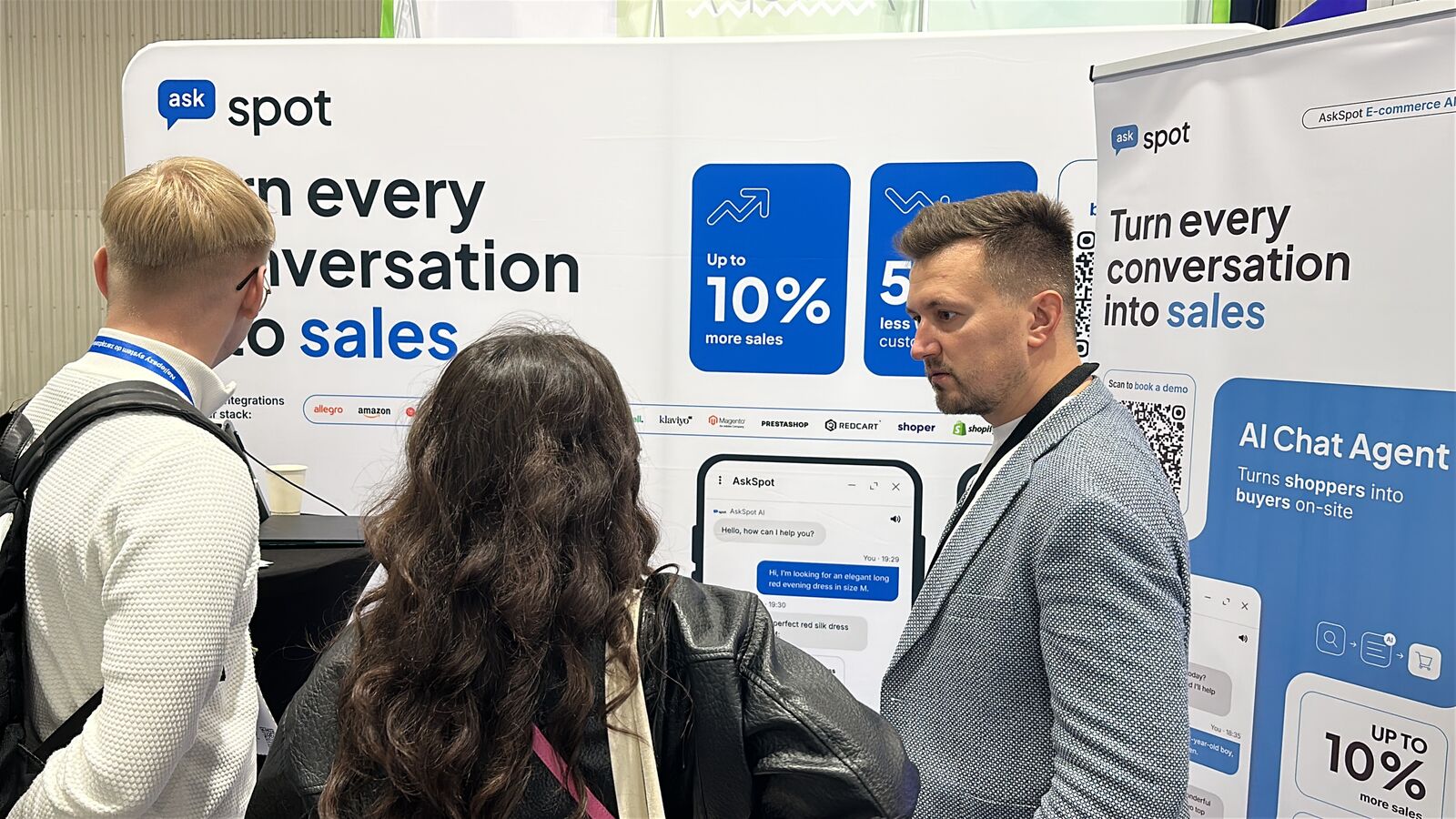
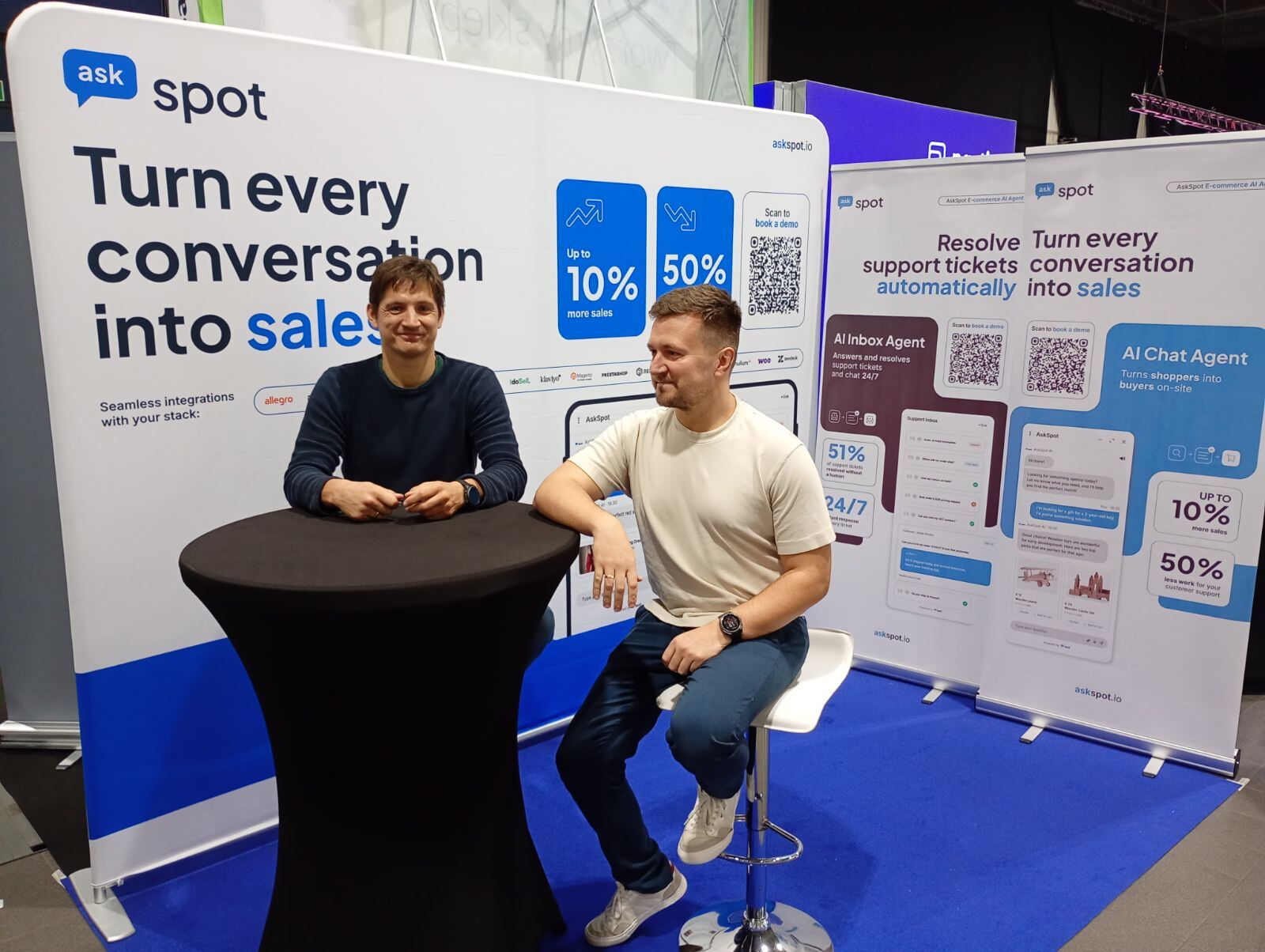
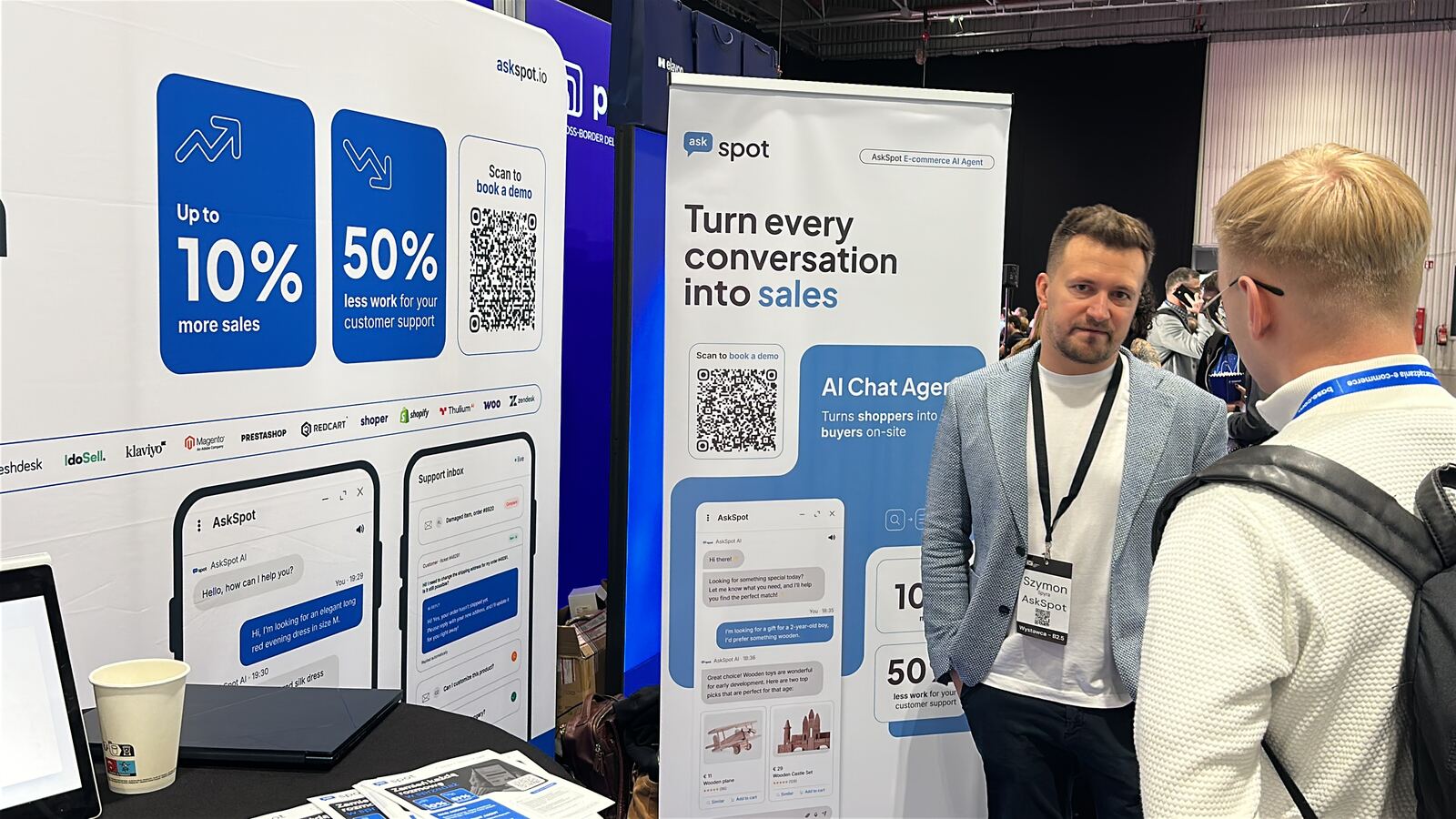
Most recently, we spent a day at our stand at E-commerce Warsaw Expo, talking to garden and furniture stores, electronics shops, coffee retailers and marketplace sellers. The live chat demo and the fact that we set the Agent up for free got the most reactions – and the questions were the ones we hear on calls every week. So here they are, answered in one place.
What exactly do I pay for?
You pay per conversation, not per seat. The AI Chat Agent costs €250 a month for up to 1,250 AI conversations; beyond that, each extra conversation is €0.18 – there is no jump to a bigger plan. A conversation is one exchange between a shopper and the Agent, and minimising the chat window doesn’t start a new one. If you run the chat on more than one store domain, each extra domain is €49 a month.
The AI Inbox Agent is optional: €120 a month for infrastructure, then €0.18 for each ticket it resolves without a human and €0.05 for each ticket it only processes – a draft, a category, a status change. Prices are net, billed monthly, with no setup fee and no long contract – you can cancel any time.
Not sure how many conversations your store would have? Estimate your monthly cost from your store traffic →
Do I pay for spam and “hi” chats?
No. Spam and single-message chats – a lone “hey” with nothing after it – are not billed as conversations. Tags and topics on each conversation help pick them out. On the Inbox side, a classification set up for your store decides whether a ticket counts as resolved, so you don’t pay for spam, unresolved issues or erroneous inquiries.
Bots are stopped before they cost you anything: AI spam detection, automatic IP blocking, Cloudflare protection and a kill switch.
Can we see it working before we pay?
Yes, in two ways. You can start a 7-day free trial – no card needed – and set the Agent up yourself in the panel. Or book a demo, and we build the Agent on your own product feed and show it to you on your catalogue.
Before the Agent talks to real customers, we run more than 100 automated test conversations and send you the report, and you can roll it out gradually. The Inbox Agent starts in test and draft modes: first it works in the background, then it drafts replies your team reviews, and only then does it answer on its own.
How long does setup take, and what do we have to do?
The chat goes live in 3–5 working days from the moment we have your product feed and access. The Inbox Agent takes about two weeks, including a week in listening mode, when it reads tickets without replying.
Your part is small. The product feed is all we need to start: the Agent builds its knowledge from the feed and your website, and adding the AI Chat Agent to your store is one script, like Google Analytics. Our team does the setup, and there is no setup fee. We heard “we don’t have time for an implementation right now” more than once at the stand – which is exactly why the setup is on us.
Does it work with our platform and our helpdesk?
Most likely, yes. Ready-made integrations cover Shopify, WooCommerce, Magento and PrestaShop, as well as Shoper, IdoSell, AtomStore and RedCart, plus BaseLinker for order data. A platform with an API can be connected as a custom integration.
On the support side, the Inbox Agent works inside Thulium, Freshdesk and Zendesk, and in the Allegro and Amazon marketplace inboxes. The full list, with what each integration does, is on the integrations page.
Can it answer emails and Allegro messages, not just the website chat?
Yes – that is the job of the AI Inbox Agent. It reads tickets in your helpdesk or marketplace inbox, answers the ones it can resolve, and classifies, tags and routes the rest, so they reach the right person with the right status. It only picks up new tickets, so it never jumps into a case your team is already handling.
For marketplace sellers, it connects to Allegro’s Message Center (here’s how to connect it) and to Amazon. It uses the same knowledge as the website chat, so customers get the same answer wherever they ask.
Can AI really handle our assortment?
Yes, because it doesn’t answer from general knowledge. It answers only from your store’s data: the product feed, your website and the product pages themselves, including size tables and delivery times. Where the feed is thin, it reads the product page, and it can even read text in product images. If the information isn’t there, it says so and passes the question to your team instead of guessing.
On top of that come rules for your industry – health questions in a supplements store go to staff, for example – and buying guides that make the Agent ask about needs before it recommends. We call it five layers of safeguards; our post on preventing AI hallucinations explains how they work.
Large, technical catalogues are where this pays off. At Senetic, a B2B IT store with seven European storefronts, the Agent answers questions about ports, PoE and compatibility – and 19.5% of those chats end in an add to cart.
 spot
See it on your own catalogue
Book a short demo – we’ll build the Agent on your product feed and show you the answers.
Does it learn by itself, or do we have to train it?
It learns by itself – and what it learns stays inside AskSpot. Your conversations and your team’s replies are never used to train external AI models.
The two Agents learn in different ways. The AI Chat Agent analyses its own conversations and proposes changes and knowledge-base updates that help it resolve more questions – someone on your team approves them before they go live. The AI Inbox Agent reads your team’s earlier replies in the inbox and learns how your team answers customers.
You keep the controls. The Agent answers from its knowledge base – your feed, your website and the Q&A entries your team adds – which you can edit at any time, and a weekly report shows the most common questions and the ones it can’t answer yet. More on this in our guide to building a chatbot knowledge base.
Who controls what it says and does?
You do. Your team edits the knowledge base and the instructions, and you decide which products the Agent puts forward: recommendations can follow your feed data, such as bestsellers or margin, or be limited to your own brands.
Actions are switched on one by one. The Agent changes an order’s status or cancels an order only if you enable that in the settings; otherwise it collects the details and passes a complete case to your team.
What happens when a customer needs a human?
The Agent hands the conversation over to the live chat you already use – Thulium, Freshdesk, LiveChat, Tawk.to and others – together with the conversation so far, so your consultant doesn’t start from zero. When nobody is available, it creates a ticket with the full conversation instead.
Most conversations never get that far: the Agent resolves up to 75% of cases without a human.
Is it GDPR-compliant?
Yes. Your store is the data controller and AskSpot is the processor, and we sign a data processing agreement (DPA) with you. Data stays on EU-hosted infrastructure (Microsoft Azure, Google Cloud), your data isn’t used to train external AI models, and the Agent doesn’t process sensitive data. The details are on our security page.
Does it make sense for a manufacturer selling B2B and B2C?
Yes, as long as there is a product feed. B2B buyers ask more technical questions – specifications, compatibility, which part goes with which – and that is exactly what the Agent answers from your data, as the Senetic example above shows. Business and retail customers on the same site talk to the same Agent; if your B2B and B2C stores run on separate domains, each one gets its own feed.
How is it different from Intercom?
Intercom is a general customer-service platform, and its AI agent, Fin, is priced per resolution on top of a per-seat plan. AskSpot is built for e-commerce only: it sells from your catalogue as well as answering support questions, and you pay per conversation, with no seats. The full AskSpot vs Intercom comparison goes through features and prices side by side. For the wider market, see our AI chatbot for ecommerce roundup of twelve tools.
What do shoppers actually ask an AI chat?
This one came up at almost every meeting. Across more than 240,000 conversations in 15 e-commerce categories, the answer depends on what you sell:
35%
of pre-purchase chats in garden stores ask about specifications
AskSpot Internal Data · 3 stores
20%
of pre-purchase chats in automotive stores ask “will it fit my car?”
AskSpot Internal Data · 3 stores
26%
of pre-purchase chats in fashion stores ask about delivery, returns and payment
AskSpot Internal Data · 3 stores
In furniture, garden and tactical gear, specifications lead; in automotive, one question in five is about fit; in fashion and beauty, delivery and returns come first. Either way, most shoppers who open the chat are still deciding what to buy – which is why the Agent’s answers come from your product data, not from a script.
Your question isn’t here?
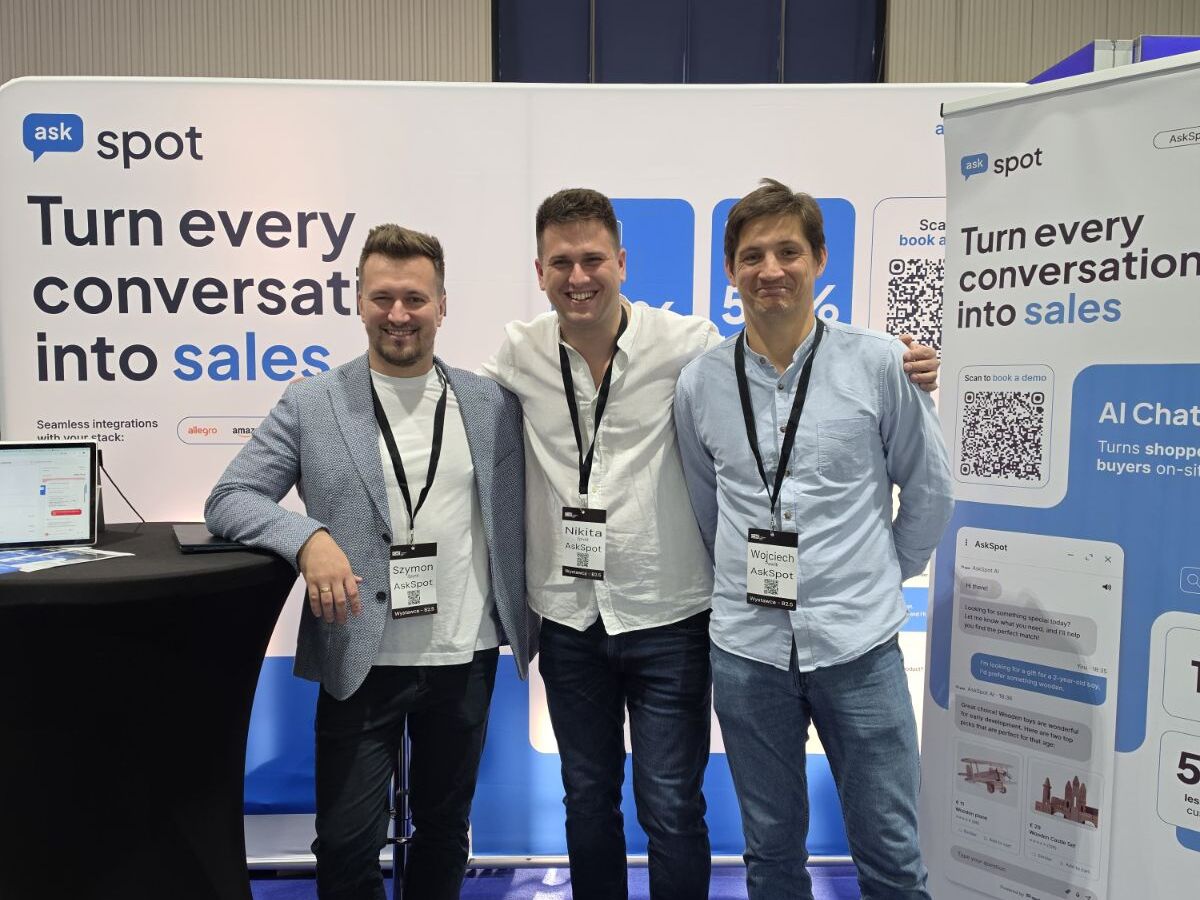
Ask us – at the next event, on a call or in the chat on this page. These are the people you’ll talk to:
Quick answers
Do I pay for spam or “hi” chats?
No. Spam and single-message chats are not billed as conversations, and bots are filtered out by AI spam detection, automatic IP blocking and Cloudflare protection.
How long does it take to set up AI chat in an online store?
The AskSpot chat goes live in 3–5 working days from receiving your product feed and access. The Inbox Agent takes about two weeks, including a week in listening mode.
Does AskSpot learn by itself?
Yes. The AI Chat Agent proposes knowledge-base updates based on its conversations, which your team approves, and the AI Inbox Agent learns from your team’s earlier replies. Your data stays in AskSpot and never trains external AI models.
Is there a free trial?
Yes – 7 days, with no card needed. You can also book a demo and see the Agent built on your own catalogue.
Is AskSpot GDPR-compliant?
Yes. AskSpot is the data processor and signs a DPA with your store, data stays on EU-hosted infrastructure, and your data isn’t used to train external AI models.