Key takeaways
- Outsourced support is priced per agent-hour, per agent per month or per resolved contact – published rates run from about $7 (€6) an hour offshore to $42 (€38) an hour onshore in the US.
- Covering one chat seat around the clock takes about 4–5 people, so 24/7 is where outsourcing gets expensive.
- Most store chats are repeat questions about products and orders – the part an AI agent answers from your catalogue and order data.
- Outsourcing still makes sense for phone support, complex B2B accounts and cases that need a person’s judgement.
- For most online stores the cheapest setup is a hybrid: AI as the first line, a small team – in-house or outsourced – for the rest.
What is customer support outsourcing?
Customer support outsourcing means hiring an external company – a BPO, a contact centre or a support agency – to answer your customers on your behalf, by chat, email, phone or social media. The provider’s agents work in your helpdesk under your brand name, follow your policies and report to you on response times and quality.
There are three common models:
- Dedicated agents – people who work only for your store, billed per hour or per month.
- Shared agents – a team that serves several clients, billed per contact or per resolution.
- Managed team – dedicated agents plus a team leader, training, quality checks and reporting, billed per agent with a management fee.
How much does it cost to outsource customer service in 2026?
Most providers quote on request, but a few publish their prices. These are the ranges they publish, in US dollars as quoted:
| Pricing model | Published price (USD / EUR) | Source |
|---|---|---|
| Per agent-hour, offshore (Asia) | $7–16 an hour €6–15 an hour | Helpware, 2026 cost guide |
| Per agent-hour, nearshore (Latin America) | $12–19 an hour €10–18 an hour | Helpware, 2026 cost guide |
| Per agent-hour, onshore (US) | $28–42 an hour €25–38 an hour | Helpware, 2026 cost guide |
| Per resolved contact | $1–7, around $4 on average €1–6, around €4 | Helpware, 2026 cost guide |
| Per full-time agent, monthly | from $1,400 (Asia-Pacific) and $1,700 (Americas) from €1,250 and €1,550 | Influx price list |
| Per part-time agent (4 hours a day), monthly | from $1,000 from €900 | Influx price list |
| Managed team, per agent, monthly | from $2,000–2,100, team leader extra from €1,800–1,900 | Influx price list |
The hourly rate isn’t the whole bill. Mid-sized providers often ask for a minimum of 5–25 seats and a setup fee of $5,000–25,000 (€4,500–22,500), according to the same Helpware guide (Influx publishes no setup fee and no minimum for single agents). Add the time you spend training agents on your products, checking their replies and retraining when people leave. And extra languages, weekends and peak-season cover usually raise the rate.
Weighing software instead of people? The same maths for chatbots is in how much an AI chatbot really costs.
What outsourcing solves for an online store – and what it doesn’t
Outsourcing buys you people and hours. It works well for:
- Coverage – nights, weekends and time zones you can’t staff yourself.
- Peaks – extra agents for Black Friday or a big launch, then back down.
- Phone – a channel that still needs a human voice.
- Judgement – exceptions, goodwill gestures and upset customers.
What it doesn’t change is the kind of work. An outsourced agent answers the same questions your team does – and in a store, most of them repeat. Across the online stores running AskSpot, 74% of chats on the median store are pre-purchase questions: product advice, specs, sizes, delivery terms. Two thirds of support emails are about orders that already exist. An outsourced agent has to learn your catalogue and look each order up by hand, exactly as your own team does now – and when they leave, the next one starts from zero.
There’s also access to think about: to answer order questions, outsourced agents need logins to your store admin or helpdesk, which means another company handling your customers’ data.
The third option: automate the repeat conversations first
An AI agent built for e-commerce answers from your product catalogue, your policies and your order data – at any hour, in the shopper’s language, without a queue. When a case needs a person, it hands the conversation over with a summary. This is what the median store running AskSpot sees:
61%
of chats arrive outside Mon–Fri 9–17
77%
of chats resolved by the AI with no human
33%
of support emails resolved automatically
Median store, AskSpot internal data, 27 Sep – 26 Oct 2026. Ranges and method in AI chatbot statistics for e-commerce.
Six in ten chats come when an office-hours team is gone – the hours that are hardest to staff. Three in four are resolved without a person. Email is harder: a third is solved automatically, and the Inbox Agent drafts replies for the rest so your team only checks and sends. More on the evening and weekend gap in 24/7 support for online stores.
 spot
Outsourcing vs AI agent vs in-house team
| Outsourced team | AI agent | In-house team | |
|---|---|---|---|
| How you pay | Per hour, per agent or per contact | Per conversation | Salaries, tools, management |
| 24/7 cover | Yes, at 4–5 people per seat | Yes, included | Rarely |
| Languages | Usually charged extra per language | The shopper’s language, included | The languages your team speaks |
| Time to start | Weeks: contract, hiring, training | Days: connect catalogue and orders | Months: hiring and training |
| Product knowledge | Learned agent by agent | Read from your catalogue feed | Deep, but lives in people’s heads |
| Order lookups and actions | By hand, with access to your systems | Automatic, through the integration | By hand |
| Upset customers, exceptions | Yes, within the rules you set | Hands over to a person | Yes |
| Phone | Yes | No – chat and email | Yes |
| Black Friday peaks | Book extra agents in advance | Scales with no booking | Overtime or temps |
Worked example: 24/7 chat for a store with 3,000 chats a month
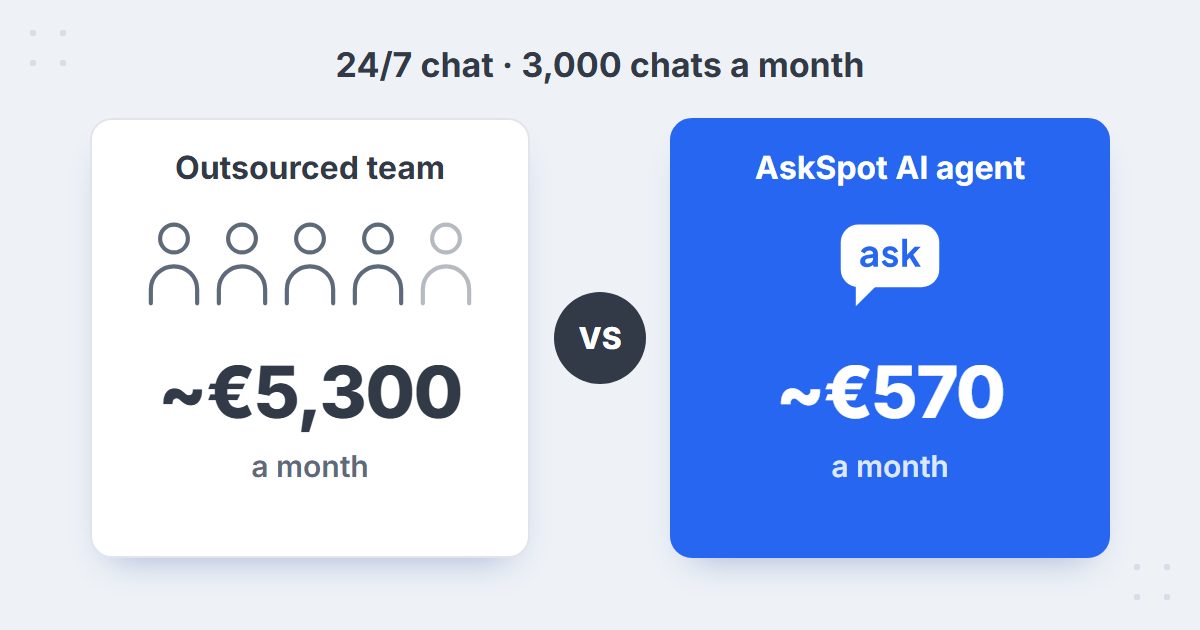
Take a store with 3,000 chats a month that wants someone answering around the clock. One seat open 24/7 is about 730 hours a month. A full-time agent covers about 170, so one seat needs at least 4.2 people – more once holidays and sick days are counted.
| Setup | How it’s calculated | Per month, about |
|---|---|---|
| Outsourced, offshore, hourly | 730 hours x $7–16 730 hours x €6–15 | $5,100–11,700 €4,400–11,000 |
| Outsourced, onshore US, hourly | 730 hours x $28–42 730 hours x €25–38 | $20,400–30,700 €18,300–27,700 |
| Outsourced, per resolved contact | 3,000 chats x $1–7 3,000 chats x €1–6 | $3,000–21,000 €3,000–18,000 |
| Outsourced, dedicated agents | 4.2 agents x $1,400 (Asia-Pacific) 4.2 agents x €1,250 | $5,900 €5,300 |
| AskSpot Chat Agent | $290 for 1,250 conversations + 1,750 x $0.22 €250 for 1,250 conversations + 1,750 x €0.18 | $675 €565 |
| Hybrid: AskSpot + one part-time agent | $675 + $1,000 (part-time agent) for the cases the AI hands over €565 + €900 | $1,675 €1,465 |
The hybrid line is the honest comparison. On the median store the AI resolves about three chats in four, so roughly 700 of the 3,000 still need a person – one part-time agent, outsourced or your own. Hand-overs that come at night become tickets that the team picks up in the morning. Outsourcing prices are the published USD rates from the table above; euro figures are converted at the ECB rate of 29 October 2026 and rounded. AskSpot prices are our own USD and EUR price lists. Outsourcing rates are starting points, so real quotes are usually higher.
Want it with your own numbers? The savings calculator on the pricing page compares AskSpot with your team’s hourly cost and time per conversation.
See which of your chats AI can take over
Book a short demo – we’ll show the agent answering questions about your own products and orders.
When outsourcing still makes sense
- Phone-heavy support. AskSpot answers chat and email, not calls. If most of your customers phone, you need people on the line.
- Complex B2B accounts. Custom quotes, contracts and account management need a person who knows the client.
- Regulated advice. Medical, financial or legal questions where only a qualified person may answer.
- Every complaint handled by a person. If that’s your policy, staff it – the AI can still route complaints to the right people with a summary. More in how to handle customer complaints.
- Back-office work. Processing returns, chasing couriers and fixing orders in the warehouse system is work for people, wherever they sit.
How to decide: five questions
- When do your customers write? If most chats come in the evening and at the weekend, 24/7 cover matters more than extra daytime hands.
- How many questions repeat? Count a week of chats and emails. Product, delivery and order-status questions are the ones AI handles best.
- Which channels? Chat and email can be automated; phone needs people.
- How many languages? Each language usually means more outsourced agents. An AI agent answers in the shopper’s language – see multilingual support.
- How much needs your systems? The more answers depend on order data, the more an agent connected to your store saves compared with someone looking things up by hand.
The hybrid setup: AI first, people second
Most stores end up with a mix. The AI agent takes the first reply on every chat and email: product questions, order status, returns rules, delivery times. Your team – in-house, outsourced or both – takes what the AI hands over. AskSpot can hand a conversation over in three ways: to your team in AskSpot’s built-in live chat, to the live chat your store already uses, or as a ticket when nobody is online.
Done this way, an outsourced team stops answering “where is my parcel?” and spends its hours on the cases that need judgement – which is also where a smaller team is enough. For what to automate first and what to keep with people, see AI customer service for e-commerce; for how live chat and AI chat work together, live chat vs AI chat. And measure the result by conversations actually solved, not just answered – deflection vs resolution rate.
Want to see how much of your own volume the AI can take? Try the Chat Agent with a 7-day free trial – no card needed.
FAQ
How much does it cost to outsource customer service?
Published 2026 rates run from about $7–16 (€6–15) an hour offshore and $12–19 (€10–18) nearshore to $28–42 (€25–38) an hour for US-based agents, or $1–7 (€1–6) per resolved contact. Dedicated agents start at around $1,400–1,700 (€1,250–1,550) a month each. Setup fees and seat minimums often come on top.
Is outsourcing customer service worth it for a small online store?
It can be for phone support or for covering hours you can’t staff. But 24/7 cover needs four to five people per seat, which is expensive for a small store. Automating the repeat chat and email questions first, and outsourcing only what’s left, usually costs less.
Can AI replace outsourced customer service?
For most chat and email questions in e-commerce, yes – product advice, order status, delivery and returns rules. On the median store running AskSpot, the AI resolves 77% of chats with no human. Phone calls, complex B2B cases and judgement calls still need people.
What’s the difference between outsourced live chat and an AI chatbot?
Outsourced live chat is people from an external company answering in your chat window, billed by the hour or per chat. An AI agent answers automatically from your catalogue and order data, at any hour, and hands over to a person when a case needs one.
Can I combine outsourcing and AI?
Yes, and it’s often the cheapest setup. The AI agent takes the first reply on every conversation and hands over the rest – to AskSpot’s built-in live chat, your store’s own live chat or as a ticket – so the outsourced team only handles the cases that need a person.
Does AI customer support work 24/7 and in several languages?
Yes. An AI agent answers at any hour and in the shopper’s language, with no extra charge for nights, weekends or languages. On the median store running AskSpot, 61% of chats arrive outside Monday–Friday office hours.